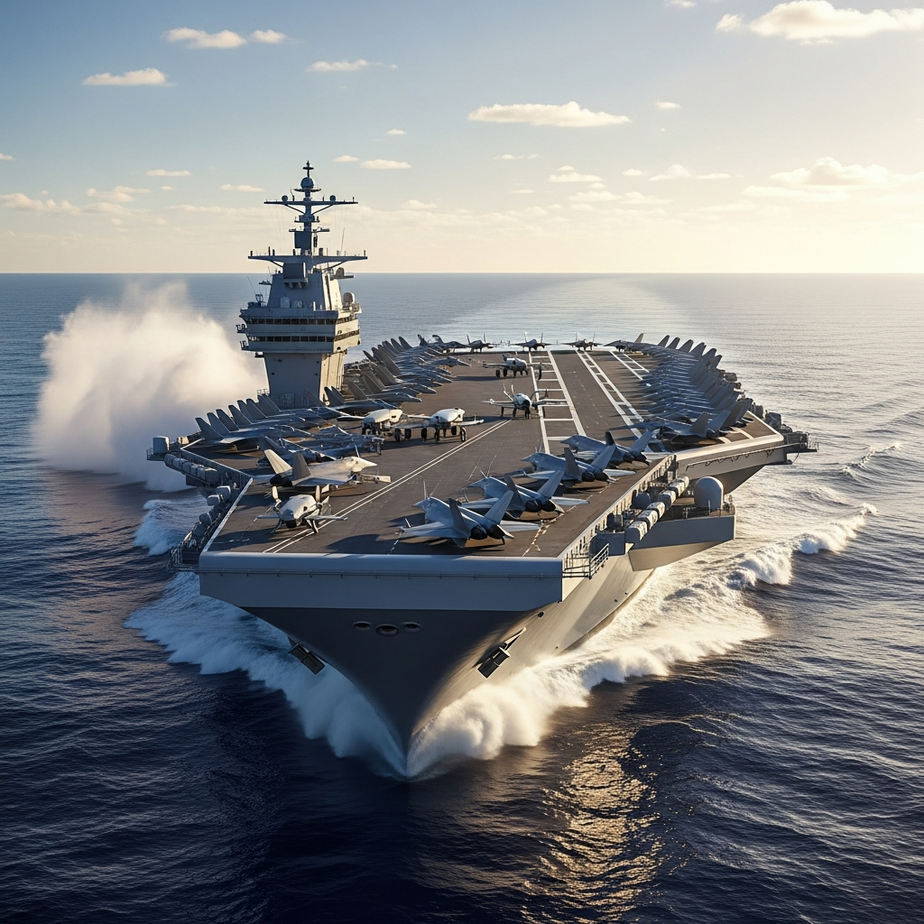
The open ocean remains one of the most strategic frontiers on Earth, and dominating it requires more than just a large fleet. It requires the ability to project air power anywhere in the world at a moment’s notice. As we move deeper into the latter half of the decade, the race to build the most powerful aircraft carriers in 2026 has accelerated significantly. Nations are investing billions into these floating cities, equipping them with next-generation technology, electromagnetic launch systems, and unmanned aerial vehicles. These massive vessels serve as the ultimate symbols of national prestige and military capability. While the fundamental concept of an aircraft carrier has not changed in a century, the technology driving them certainly has. By 2026, we are seeing a shift away from traditional steam-powered catapults toward digital, electric systems that can launch heavier payloads with greater precision. This evolution is reshaping the balance of power across the world’s oceans, making the modern carrier strike group more lethal and efficient than ever before.
The Evolution of Naval Supremacy
For decades, naval supremacy was defined simply by tonnage and the number of aircraft a ship could carry. While size still matters, the definition of power has become far more nuanced. In the current geopolitical landscape, a carrier’s effectiveness is measured by its sortie generation rate, the sophistication of its sensor suites, and its ability to integrate with satellite networks and unmanned drones. The most powerful aircraft carriers in 2026 are not just airfields at sea; they are mobile command centers capable of managing entire theaters of war. They operate as part of a larger ecosystem known as the carrier strike group, which includes destroyers, cruisers, and submarines. This layered defense ensures that the carrier remains a hard target while projecting offensive power hundreds of miles inland. Furthermore, the integration of artificial intelligence and automated logistics has reduced the crew size needed for daily operations while increasing the speed at which aircraft can be refueled and rearmed. As we look at the top contenders sailing the seas this year, it is clear that technology is the primary differentiator between a floating runway and a true supercarrier.
USS Gerald R. Ford Class: The American Titan
When discussing naval dominance, it is impossible to ignore the United States Navy. In 2026, the USS Gerald R. Ford remains the undisputed king of the ocean. As the lead ship of her class, she represents a generational leap over the legendary Nimitz-class carriers that served as the backbone of the US fleet for decades. What makes the Ford class the leader among the most powerful aircraft carriers in 2026 is its adoption of the Electromagnetic Aircraft Launch System, known as EMALS. Unlike traditional steam catapults, which are maintenance-heavy and place significant stress on airframes, EMALS uses linear induction motors to accelerate aircraft. This allows for smoother launches and the ability to launch a wider variety of aircraft, from heavy fighters to light unmanned drones.
Key Technological Advantages
The Ford class also features the Advanced Arresting Gear (AAG), which replaces hydraulic arresting wires with an electric motor system. This provides finer control when catching incoming aircraft, reducing wear and tear on expensive jets like the F-35C Lightning II. Beyond launch and recovery, the ship’s design focuses on efficiency. The flight deck has been rearranged to maximize the sortie generation rate, allowing the crew to launch and recover planes up to 33 percent faster than previous classes. The island superstructure is smaller and set further back, creating more deck space for aircraft maintenance and movement. Powered by two A1B nuclear reactors, the USS Gerald R. Ford can generate three times the electrical power of the Nimitz class. This excess energy is crucial for the future, as it provides the capacity to support directed-energy weapons and high-powered lasers that are expected to become standard defensive tools in the coming years.
China’s Type 003 Fujian: A New Challenger Approaches
For years, China’s naval aviation relied on carriers that utilized a ski-jump ramp for launching aircraft. While functional, this design limited the amount of fuel and munitions a jet could carry, thereby restricting its range and combat effectiveness. The introduction of the Type 003 Fujian has fundamentally altered this dynamic. By 2026, the Fujian has cemented itself as a premier blue-water asset. It is the first Chinese carrier to utilize a catapult system comparable to the American EMALS. This transition from Short Take-Off But Arrested Recovery (STOBAR) to Catapult Assisted Take-Off But Arrested Recovery (CATOBAR) allows the People’s Liberation Army Navy to launch heavier aircraft, including airborne early warning and control planes similar to the US E-2D Hawkeye.
Strategic Implications in the Pacific
The Fujian is massive, displacing over 80,000 tons, placing it firmly in the supercarrier category. Its existence signals a shift in strategy from coastal defense to global power projection. The ability to launch fully loaded J-15 and next-generation stealth fighters means that the Fujian can contest air superiority far from the Chinese mainland. Observers from organizations like the U.S. Naval Institute have noted that the speed of China’s shipbuilding and technological adaptation is unprecedented. The Fujian is not just a copy of Western designs; it incorporates indigenous radar and missile defense systems that make it a formidable adversary. In 2026, this vessel stands as the most potent symbol of the shifting naval balance in the Pacific region.
HMS Queen Elizabeth: The Pride of the Royal Navy
The United Kingdom took a different approach when designing its flagship vessels, but the result is no less impressive. The HMS Queen Elizabeth, along with her sister ship the HMS Prince of Wales, represents a unique philosophy in carrier operations. Rather than nuclear power and catapults, the Royal Navy opted for a gas turbine propulsion system and a Short Take-Off and Vertical Landing (STOVL) configuration. This design choice was specifically tailored to the F-35B Lightning II, the world’s most advanced STOVL stealth fighter. In 2026, the HMS Queen Elizabeth operates as a specialized 5th-generation carrier. The lack of catapults and arresting gear simplifies operations and reduces mechanical complexity, allowing for high availability rates.
The Twin-Island Innovation
One of the most distinct visual features of the Queen Elizabeth class is the twin-island superstructure. The forward island houses the bridge and is dedicated to ship navigation, while the aft island controls flight operations. This separation increases survivability; if one island is damaged in combat, the other can take over critical functions. Despite not being a nuclear vessel, the ship has a global reach, supported by a fleet of new logistical tankers. Its automated weapons handling system is highly sophisticated, significantly reducing the number of crew members required to move munitions from the magazine to the flight deck. As one of the most powerful aircraft carriers in 2026, the HMS Queen Elizabeth serves as a central node for NATO naval operations in the Atlantic and Mediterranean.
INS Vikrant: The Face of Indian Self-Reliance
India has a long history of operating aircraft carriers, but the INS Vikrant marks a turning point as the country’s first indigenously designed and built carrier. Commissioned earlier in the decade, by 2026 the Vikrant has reached full operational maturity, serving as the cornerstone of the Indian Navy’s Eastern Fleet. The Vikrant utilizes a STOBAR configuration with a ski-jump ramp. While this limits the maximum takeoff weight compared to catapult-equipped ships, it is a highly effective design for the specific defense needs of the Indian Ocean Region. The ship carries a mix of MiG-29K fighters and arguably more modern helicopters tailored for anti-submarine warfare.
Regional Dominance
The significance of the INS Vikrant lies in what it represents for regional stability. With rising tensions in maritime trade routes, having a dedicated carrier battle group allows India to secure vital shipping lanes. The ship is equipped with the Barak-8 surface-to-air missile system, providing a robust shield against aerial threats. In 2026, the integration of new multi-role helicopters and potential naval variants of indigenous fighters has boosted the Vikrant’s lethality. It proves that a nation does not need to rely on foreign superpowers to build and maintain a credible carrier capability. The success of the Vikrant has also paved the way for discussions regarding a larger, catapult-equipped successor in the near future.
Charles de Gaulle: Europe’s Nuclear Spearhead
France remains the only nation outside of the United States to operate a nuclear-powered aircraft carrier. The Charles de Gaulle may be physically smaller than the American supercarriers, but its capabilities are disproportionately high. In 2026, it remains the absolute centerpiece of the French Navy and a critical asset for European defense. Because it is nuclear-powered, the Charles de Gaulle has unlimited range and can sail for years without refueling, limited only by provisions for the crew. It utilizes a CATOBAR system, allowing it to launch the Rafale M, a highly versatile omnirole fighter that has seen extensive combat service.
Interoperability and Upgrades
Recent mid-life upgrades have kept the Charles de Gaulle relevant in the modern era. Updates to its radar, communications, and combat management systems ensure it can seamlessly integrate with US and NATO forces. The ability for American F/A-18s and French Rafales to operate off each other’s decks demonstrates a level of interoperability that few other alliances possess. While France is already planning a next-generation successor known as the PANG, the Charles de Gaulle continues to hold its ground as one of the most powerful aircraft carriers in 2026. Its presence in the Mediterranean or the Indo-Pacific serves as a strong diplomatic and military statement, proving that nuclear propulsion is a game-changer for sustained naval operations.
What Defines Power on the High Seas in 2026?
Identifying the most capable warships involves looking beyond the hull and into the air wing and digital infrastructure. The true power of these vessels in 2026 comes from the “system of systems” approach. A carrier is no longer a standalone asset; it is a data hub that fuses information from satellites, submarines, and aircraft to create a comprehensive picture of the battlefield.
The Rise of Unmanned Systems
The most significant trend we are seeing this year is the widespread adoption of unmanned aerial vehicles (UAVs). In the past, carriers were strictly for manned fighter jets. Now, drones are taking on roles ranging from aerial refueling to surveillance and electronic warfare. The US Navy’s MQ-25 Stingray is a prime example. By refueling manned fighters in mid-air, it significantly extends the strike range of the carrier air wing, keeping the ship itself safely out of range of enemy anti-ship missiles. Similar drone programs are being aggressively pursued by China and Turkey, signaling that the future air wing will be a hybrid of manned and unmanned systems.
Hypersonic Defense
Another factor influencing the ranking of these ships is their ability to defend against modern threats. The proliferation of hypersonic missiles has forced navies to upgrade their defensive layers. The carriers listed above are all equipped with, or escorted by ships equipped with, advanced kinetic and electronic countermeasures designed to confuse or intercept missiles traveling at five times the speed of sound. Power in 2026 is also about resilience. The ability to sustain damage, fight through cyber-attacks, and continue flight operations in a GPS-denied environment is what separates a top-tier navy from a coastal defense force.
The Future of Naval Aviation
As we survey the oceans in 2026, it is clear that the aircraft carrier remains the undisputed capital ship of major navies. The US continues to lead with the Ford class, setting the technological standard that others strive to match. However, the gap is narrowing. China’s rapid advancement with the Fujian and the distinct strategies employed by the UK, India, and France highlight a diverse and competitive naval landscape. These vessels are marvels of engineering, housing thousands of sailors and the most advanced aerospace technology in existence. They are political tools as much as they are weapons of war, capable of delivering humanitarian aid one day and precision strikes the next. For enthusiasts and defense watchers, the evolution of these giants is a fascinating area to monitor. The integration of AI, lasers, and drone swarms is just beginning, promising even more radical changes in the decade to come. To stay informed on how these technologies continue to reshape global security, keep following the latest updates in naval defense and maritime strategy.