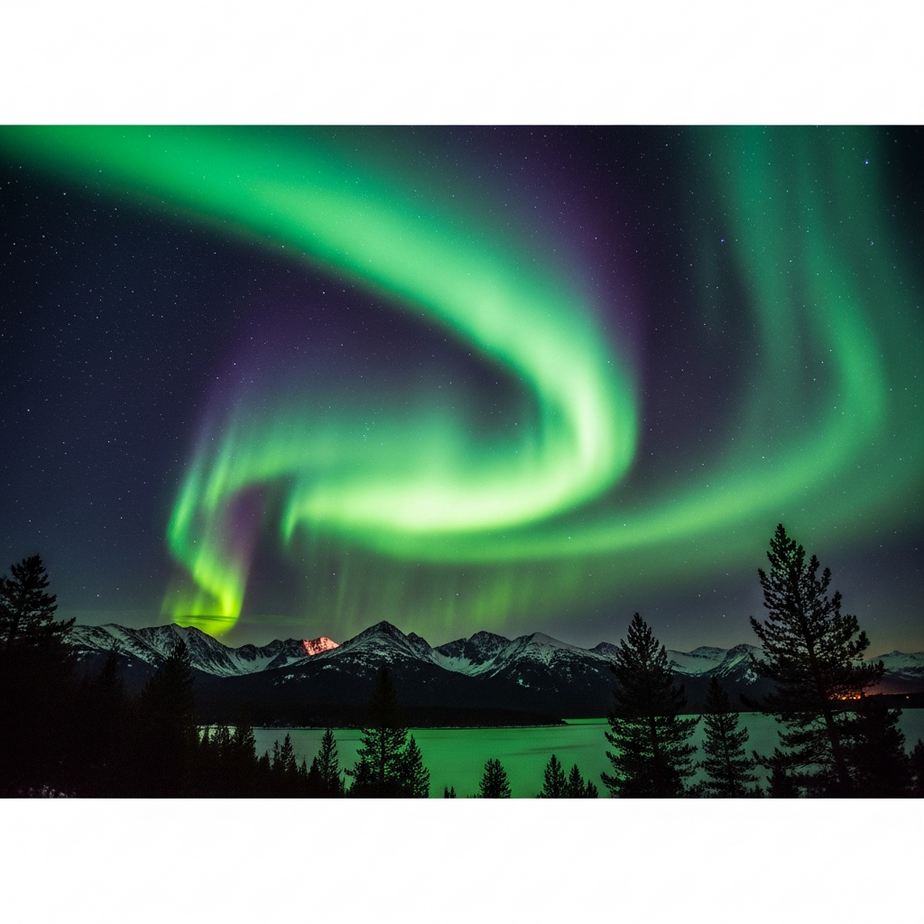
Have you ever found yourself staring up at the night sky, hoping for a glimpse of something truly magical? Well, tonight might just be your night. A spectacular and rare event is unfolding hundreds of millions of miles away, and its effects are set to create a celestial spectacle right here on Earth. The northern lights forecast for tonight is unlike anything we’ve seen in a long time, thanks to a powerful eruption on the sun’s surface. This isn’t just a show for those in the far north; the energy barreling toward our planet is so intense that the aurora could dip down into latitudes that rarely, if ever, get to witness its ethereal dance. So, grab a warm drink and get ready, because the cosmos is about to put on a show you won’t want to miss.
What’s Causing This Incredible Celestial Event?
The story of tonight’s potential aurora display begins 93 million miles away, on the surface of our sun. Recently, a massive sunspot—a magnetically complex region on the sun—unleashed a colossal X-class solar flare. Think of it as the most powerful explosion our solar system can produce. This wasn’t just a flash of light, though. The flare was accompanied by something called a Coronal Mass Ejection, or CME.
In simple terms, a CME is like the sun throwing a massive cloud of charged particles and magnetic fields out into space. Most of the time, these CMEs miss Earth entirely, flying off in other directions. But this time, the eruption was aimed directly at us. This fast-moving cloud of solar material is now racing across the solar system, and it’s expected to collide with Earth’s magnetic field within hours.
When this highly energized cloud of particles interacts with our planet’s protective magnetosphere, it’s like shaking a snow globe. The collision transfers enormous amounts of energy into our upper atmosphere. This energy excites the atoms and molecules of oxygen and nitrogen, causing them to glow. The result is the beautiful, shimmering curtains of light we know as the aurora borealis, or northern lights.
Understanding the G4 (Severe) Geomagnetic Storm Watch
You might be hearing the term “G4” or “Severe Geomagnetic Storm” in the news, and it sounds pretty intense. So, what does it actually mean? Scientists use a five-level “G-scale” to measure the severity of these solar storms, much like meteorologists use categories for hurricanes. The scale runs from G1 (Minor) to G5 (Extreme).
A G4 storm is the second-highest level, indicating a very significant event. According to the experts at the NOAA Space Weather Prediction Center, these storms are rare and can have wide-ranging effects. While they can potentially cause some issues with power grids, satellite communications, and GPS systems, they also produce the most stunning auroral displays.
Here’s a quick breakdown of the scale:
– G1 (Minor): Aurora is often visible in high-latitude areas like Alaska and northern Canada.
– G2 (Moderate): The aurora line can extend down into the northern United States.
– G3 (Strong): The lights may be seen as far south as Illinois and Oregon.
– G4 (Severe): This is what’s predicted for tonight. The aurora could be visible in places like Alabama and northern California.
– G5 (Extreme): The most powerful storms can push the aurora into Florida and southern Texas.
The current G4 watch means the northern lights forecast for tonight is incredibly promising for millions of people who have never had the opportunity to see them before. It is this high level of solar activity that makes the prospect of a widespread light show so exciting.
Where and When to Look for the Aurora Tonight
The million-dollar question on everyone’s mind is: “Will I be able to see it from my backyard?” The answer depends on a few key factors: your location, the sky conditions, and timing. With a G4 storm, the auroral oval—the ring of light that typically sits over the polar regions—expands dramatically. This means areas in the northern half of the United States have a very real chance of seeing something.
Breaking Down the Northern Lights Forecast for Tonight
States like Washington, Montana, North Dakota, Minnesota, Wisconsin, Michigan, and most of New England are prime candidates for a great show. However, the energy from this storm is so significant that the aurora could be visible on the northern horizon for people in states much farther south. There have been reports during past G4 storms of sightings in places like Virginia, North Carolina, Arkansas, and even Arizona.
The best time to start looking is as soon as it gets fully dark, typically an hour or two after sunset. The peak activity from a geomagnetic storm can be unpredictable, often occurring in waves. Auroral displays can last for hours, with periods of intense, fast-moving lights followed by lulls. Your best bet is to plan on being outside for a while, staying patient, and keeping your eyes on the northern sky.
Your Guide to a Successful Aurora Hunt
Seeing the aurora, especially from mid-latitudes, requires a bit of strategy. You can’t just step outside and expect to see vibrant colors filling the sky. Following a few simple steps can dramatically increase your chances of witnessing this natural wonder.
1. Escape the City Lights: This is the most important rule of aurora hunting. Light pollution from cities and towns will wash out the faint glow of the aurora. Use a dark sky map online to find a park, rural area, or any spot away from artificial lights. Even driving 20-30 minutes out of town can make a huge difference.
2. Check Your Local Weather: The most powerful solar storm in the world won’t matter if you have a thick blanket of clouds overhead. Check your local weather forecast for clear skies. A clear view of the northern horizon is essential.
3. Look to the North: For viewers in the mid-latitudes, the aurora will almost always appear on the northern horizon. Find a viewing spot with an unobstructed view to the north, away from tall trees or buildings. It might start as a faint, whitish-gray arc before building in intensity and color.
4. Give Your Eyes Time to Adjust: Your eyes need at least 15-20 minutes to become fully adapted to the darkness. Avoid looking at your bright phone screen during this time. If you need a flashlight, use one with a red light setting, as it is less disruptive to your night vision.
5. Be Patient and Persistent: The aurora is not a constant, steady light. It shimmers, changes, and moves in waves. There might be a brilliant burst of activity for 15 minutes, followed by an hour of quiet. Don’t give up if you don’t see anything right away. The best parts of the show often come when you least expect them.
How to Photograph the Northern Lights
Capturing a good photo of the aurora can be a rewarding experience, and you don’t necessarily need professional gear. Modern smartphones are surprisingly capable of photographing the northern lights, but a DSLR camera will give you more control and better results.
Using a Smartphone
The key to a good smartphone photo is stability and a long exposure. Use a small tripod to keep your phone perfectly still. Switch to “Night Mode” or a similar setting that allows for an exposure of several seconds. If you can, use a pro mode to manually set your focus to infinity and adjust your shutter speed to between 5 and 20 seconds.
Using a DSLR or Mirrorless Camera
For more advanced photographers, a sturdy tripod is non-negotiable. Use a wide-angle lens with a fast aperture (f/2.8 or lower is ideal). Set your focus manually to infinity—you can do this by focusing on a distant star. Start with these settings and adjust as needed: set your ISO between 1600 and 6400, your aperture as wide as it will go, and your shutter speed between 8 and 25 seconds. A remote shutter or a 2-second timer will prevent camera shake when you take the picture.
Remember, your camera can often see more color than your naked eye. At lower latitudes, the aurora might appear as a faint, shimmering gray or white glow to your eyes, but your camera will reveal the hidden greens and purples. Take a test shot of the northern sky even if you don’t think you see anything.
Tonight represents a rare and beautiful opportunity to connect with the cosmos in a profound way. The energy that has traveled across millions of miles of space is arriving at our planet to put on a breathtaking display. By understanding what’s happening and preparing for the best viewing experience, you can turn this astronomical event into a lifelong memory. So step outside, look up, and be ready to be amazed. It’s a powerful reminder that we are part of a vast and dynamic universe, filled with incredible wonders waiting to be seen. Happy aurora hunting!