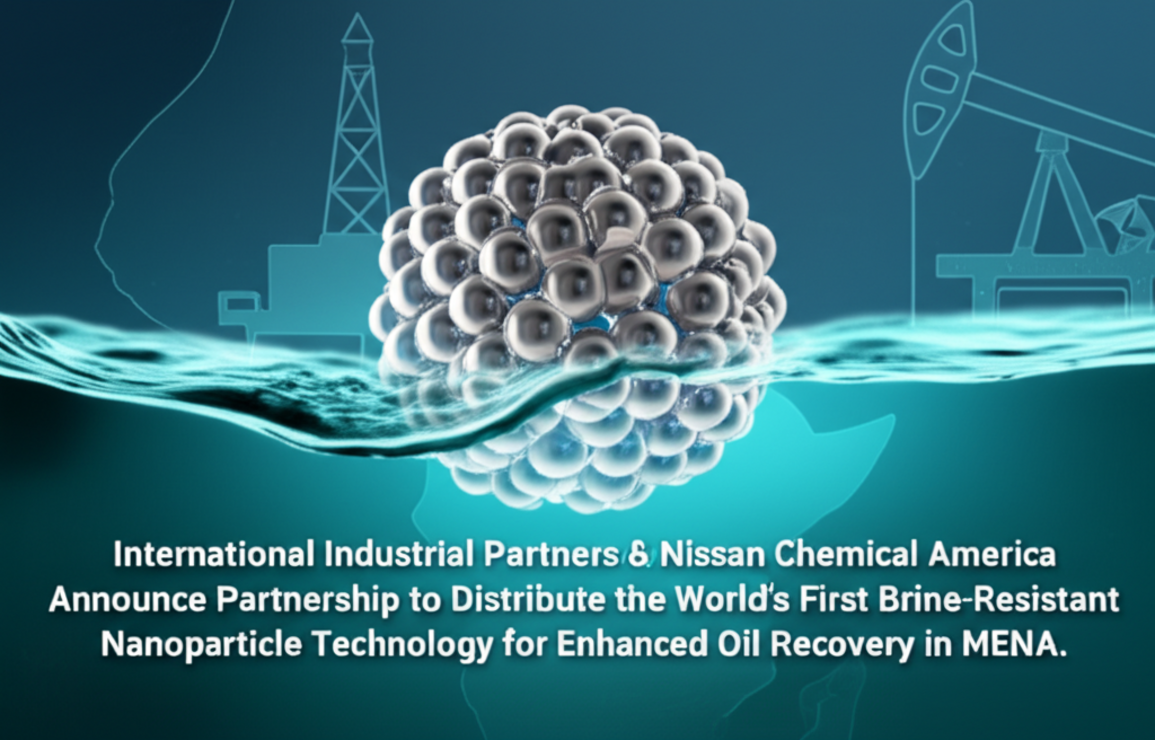
In a strategic move poised to reshape the oil‑and‑gas sector in the Middle East and North Africa, International Industrial Partners (IIP) has inked a distributor partnership with Nissan Chemical America to roll out the world’s first brine‑resistant nanoparticle technology, nanoActiv®. This collaboration signals a new era of enhanced oil recovery (EOR) that blends cutting‑edge chemistry with proven industrial expertise to unlock stranded reserves while mitigating environmental impacts.
What is nanoActiv® and Why It Matters
Developed by Nissan Chemical America, nanoActiv® is a suite of nanoparticles engineered to survive and perform in the harshest brine conditions encountered during secondary and tertiary oil recovery. Traditional EOR agents often lose efficacy in highly saline formations, limiting the scope and profitability of extraction projects. NanoActiv® addresses this by maintaining structural integrity and reactivity even in brine concentrations that exceed 200,000 ppm.
Key features include:
- High salinity tolerance: Nanoparticles resist aggregation and preserve surface activity in extreme brine.
- Improved sweep efficiency: Enhanced wettability alteration increases the fraction of oil displaced.
- Lower environmental footprint: The technology reduces the need for large volumes of chemicals and water.
- Scalable production: Manufactured at commercial scales, making it accessible to projects of all sizes.
By integrating nanoActiv® into conventional EOR processes—such as surfactant flooding, polymer injection, or CO₂‑enhanced recovery—operators can achieve up to 15 % higher ultimate recoverable oil from mature fields, translating into significant revenue uplift for stakeholders.
Why MENA is the Ideal Launchpad
The MENA region hosts some of the world’s most prolific yet under‑productive fields. High salinity is a perennial challenge, with brine concentrations routinely surpassing 300,000 ppm in the Arabian‑Arabian Gulf and Gulf of Suez. These conditions hamper conventional EOR agents and inflate operational costs.
Deploying nanoActiv® in this market offers several strategic advantages:
- Resource optimization: Unlocks stranded hydrocarbons without the need for new drilling, aligning with global decarbonization goals.
- Economic resilience: Enhances recovery rates, boosting local production and reinforcing energy security.
- Technology transfer: Facilitates knowledge exchange between IIP’s extensive field experience and Nissan Chemical America’s innovation pipeline.
- Regulatory alignment: Supports emerging ESG mandates by reducing chemical usage and water consumption.
With IIP’s strong regional presence—including long‑standing relationships with major MENA operators—nanoActiv® is positioned for rapid adoption across Saudi Arabia, UAE, Qatar, and Egypt.
The Strategic Value of the IIP‑Nissan Chemical Partnership
IIP brings a track record of successful EOR implementations, deep understanding of field‑specific challenges, and a robust distribution network across the Gulf Cooperation Council (GCC). Nissan Chemical America contributes advanced research, scalable manufacturing, and a portfolio of patented nanoparticle formulations.
Key synergies include:
- End‑to‑end delivery: From lab‑to‑field conversion to on‑site support, ensuring seamless integration.
- Co‑marketing initiatives: Joint case studies, webinars, and industry conferences to accelerate awareness.
- Data‑driven optimization: Real‑time monitoring of nanoparticle performance using IIP’s field‑deployed sensors.
By combining complementary strengths, the partnership reduces time‑to‑market for nanoActiv® while enhancing customer confidence through proven results and comprehensive technical support.
Case Study Snapshot: A Pilot in the Gulf of Suez
During a pilot deployment in Egypt’s Gulf of Suez, a 40‑year‑old field suffering from high brine levels demonstrated a 10 % boost in oil recovery after incorporating nanoActiv® into a polymer‑surfactant flood. Production increased from 2,400 bbl/day to 2,640 bbl/day—a 240 oil‑barrel‑per‑day gain translating to ~$2.5 million annually.
Operators reported:
- Reduced chemical consumption by 30 %.
- Lowered water handling costs due to improved brine resistance.
- No observable impact on existing equipment or infrastructure.
These outcomes reinforce the commercial viability of nanoActiv® and illustrate how IIP can leverage its field expertise to deliver tangible ROI.
Environmental and ESG Implications
Enhanced oil recovery has long been seen as a bridge technology toward a cleaner energy future. By maximizing oil recovery from existing wells, fewer new wells need to be drilled, thus reducing land disturbance, seismic risk, and associated carbon emissions. NanoActiv® further contributes by:
- Minimizing chemical waste: High efficacy means less volume of chemicals injected.
- Lowering water usage: Brine‑resistant formulations cut down on the water needed for flooding operations.
- Facilitating CO₂ capture: The technology is compatible with CO₂‑EOR, enabling carbon sequestration as a by‑product.
For operators in the MENA region, this translates to stronger ESG metrics—crucial for attracting international investors and meeting emerging regulatory frameworks.
Looking Ahead: Scale and Innovation
With the partnership in place, IIP and Nissan Chemical America plan to roll out nanoActiv® across multiple MENA pipelines over the next three years. Expansion strategies include:
- Integrating the technology into offshore platforms where brine challenges are even more pronounced.
- Collaborating with national oil companies to create joint venture models for technology deployment.
- Exploring cross‑border applications in the Levant and North Africa, where saline formations are equally demanding.
Meanwhile, both companies are investing in R&D to develop next‑generation nanoparticle blends tailored for specific field conditions—such as ultra‑high salinity or ultra‑tight reservoirs—ensuring nanoActiv® remains at the cutting edge of EOR solutions.
Conclusion: A Win‑Win for Industry and Communities
The IIP‑Nissan Chemical partnership marks a significant milestone in the evolution of enhanced oil recovery. By marrying world‑class nanotechnology with deep field expertise, the alliance offers a proven pathway to unlock dormant hydrocarbon resources in the MENA region while advancing environmental stewardship and economic resilience.
For operators, the immediate payoff lies in higher recovery rates, reduced operational costs, and strengthened ESG performance. For communities and governments, the benefits include sustained energy supply, job creation, and reduced ecological footprints.
As the oil industry navigates a complex transition, initiatives like this partnership demonstrate that technological innovation and strategic collaboration can pave the way for a more efficient, responsible, and profitable energy future.