You’ve seen the promises on the packaging: “Lasts 15 Years!” or “25,000-Hour Lifespan!” So you invested in LED bulbs, expecting to set it and forget it for the next decade. Yet here you are, standing on a chair, replacing another one that died years before its time. If you’re tired of this frustrating cycle, you’re not alone. The truth is, there are several hidden reasons your LED bulbs fizzle out fast, and most of them have nothing to do with a faulty bulb. It’s often the environment you put them in that silently seals their fate.
Understanding these underlying issues is the key to unlocking the true, long-lasting potential of your LED lighting. It’s about shifting focus from just the bulb to the entire system—the fixture, the switch, and the wiring in your walls. Let’s illuminate the seven expert-backed reasons for premature LED failure and how you can fix them for good.
The Overheating Epidemic: Heat is the #1 Enemy of LEDs
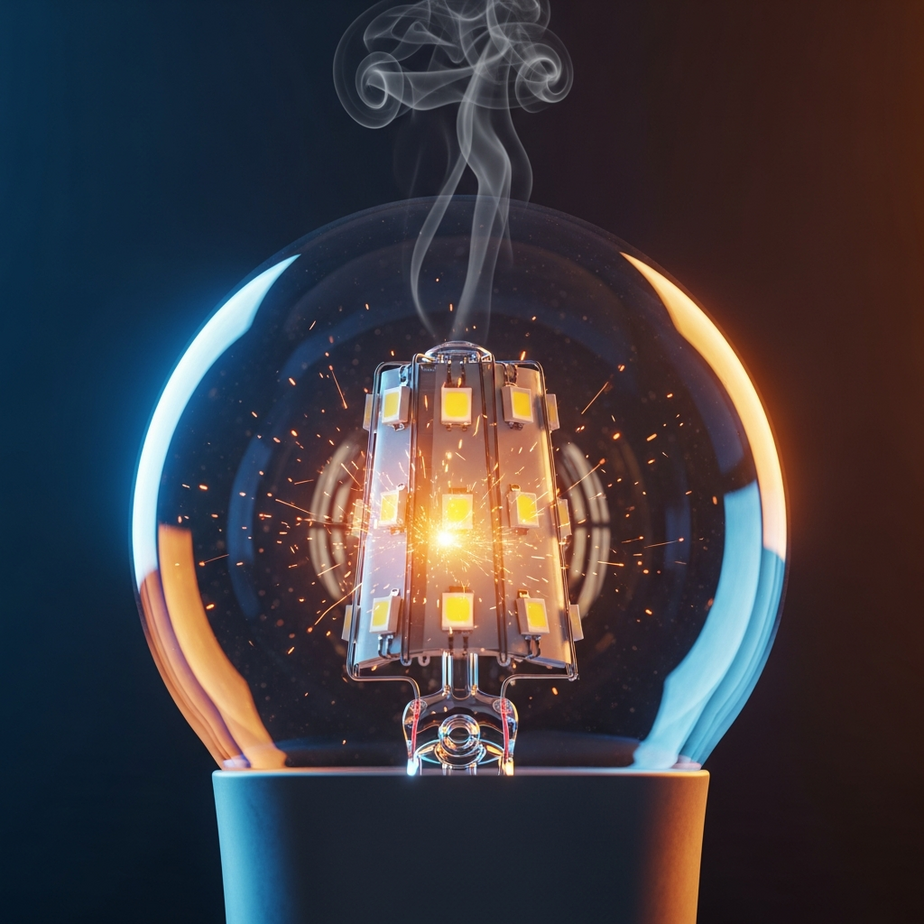
It’s the ultimate paradox of LED technology. While the light-emitting diode itself produces very little heat, the electronic components powering it certainly do. The small, sensitive circuit board inside the base of every LED bulb, known as the driver, is highly susceptible to high temperatures. When this heat has nowhere to go, it slowly cooks the driver’s components, drastically shortening the bulb’s lifespan.
Unlike incandescent bulbs that are designed to withstand extreme heat, LEDs are fundamentally electronics. Think of them like a tiny computer; you wouldn’t run your laptop inside a sealed, unventilated box and expect it to last. This heat management issue is one of the most common reasons your LED bulbs fizzle out fast.
Trapped Heat in Enclosed Fixtures
The single biggest culprit for overheating is placing an LED bulb inside an enclosed or semi-enclosed fixture. We’re talking about recessed ceiling cans, glass dome lights, sealed outdoor lanterns, and any fixture where air cannot freely circulate around the bulb. These fixtures act like a convection oven, trapping the heat generated by the driver.
The components, especially the electrolytic capacitors on the driver board, begin to degrade under this constant thermal stress. Over time, their performance dwindles until the driver fails completely, and the light goes out. The LED chip itself might still be perfectly fine, but a dead driver means a dead bulb.
How to Fix It
– Look for the Rating: When buying bulbs for these locations, specifically look for ones rated for “enclosed fixtures.” These bulbs are engineered with more robust components and superior thermal management to handle the higher temperatures.
– Consider Vented Fixtures: If you’re updating fixtures, consider models that allow for better airflow. For recessed lighting, newer LED trim kits are designed as an integrated system that dissipates heat more effectively than a simple bulb-in-a-can setup.
Poor Heatsink Design
The base of an LED bulb, typically made of aluminum or a ceramic composite, isn’t just for screwing it in. It’s a critical component called a heatsink, designed to pull heat away from the internal electronics and dissipate it into the air. The effectiveness of this heatsink is a major differentiator between high-quality and bargain-bin bulbs.
To cut costs, cheap manufacturers often use less material, inferior materials, or a less effective design for their heatsinks. A poorly designed heatsink simply can’t shed heat fast enough, leading to the same internal cooking effect, even in an open-air fixture.
Power Quality Problems You Can’t See
The electricity flowing through your home’s wiring isn’t always a perfect, stable current. It’s subject to fluctuations, spikes, and noise from appliances, the power grid, and even your light switches. The sensitive electronics inside LED bulbs are far more vulnerable to this “dirty power” than old-fashioned incandescent bulbs ever were.
These electrical issues can cause both sudden death and a slow, agonizing decline for your LED bulbs, representing some of the most invisible reasons your LED bulbs fizzle out fast.
Voltage Spikes and Power Surges
Every time a large appliance like an air conditioner, refrigerator, or vacuum cleaner kicks on, it can cause a small voltage spike or fluctuation on your home’s electrical circuit. While you won’t notice these micro-surges, the delicate driver inside your LED bulb does. Each little jolt puts stress on the components, slowly degrading them over months or years.
A major power surge, such as from a nearby lightning strike or a utility grid issue, can deliver an instant killing blow. This is why you might find multiple bulbs have died simultaneously after a storm.
How to Protect Your Bulbs
– Whole-Home Surge Protection: The best solution is a whole-home surge protector installed at your main electrical panel. This acts as a gatekeeper, shielding all of your electronics—including your LED bulbs—from damaging external and internal surges.
– Point-of-Use Protection: For expensive or critical lighting, like a chandelier with many pricey bulbs, ensure the circuit it’s on is protected by a high-quality surge protector.
Incompatible Dimmer Switches
This is perhaps the most widespread and misunderstood cause of premature LED failure. If you swap an old incandescent bulb with a new dimmable LED on a traditional dimmer switch, you’re creating a recipe for disaster. Older dimmers were designed to work by simply reducing the voltage to a simple tungsten filament.
LEDs require a much more sophisticated method of dimming. When paired with an incompatible legacy dimmer, the bulb’s driver is subjected to a choppy, unstable electrical signal. This leads to a host of problems:
– Audible buzzing or humming from the bulb.
– Annoying flickering or strobing, especially at low light levels.
– A limited dimming range (e.g., it only dims to 50% before shutting off).
– Extreme electrical stress on the driver, causing it to fail very quickly.
According to lighting experts at the American Lighting Association, this mismatch is a leading technical service complaint. It’s a critical but often-overlooked factor.
How to Fix It
– Check Your Switch: Look for dimmers that are specifically rated for LED and CFL bulbs. These are often labeled as C.L, ELV (Electronic Low Voltage), or MLV (Magnetic Low Voltage) dimmers.
– Buy a Matched Set: When possible, buy bulbs and dimmers that have been tested for compatibility. Many reputable lighting manufacturers, like Lutron, provide compatibility lists on their websites to take the guesswork out of pairing.
The Vibration and Impact Factor
LEDs are “solid-state lighting,” which means they don’t have delicate, brittle filaments like incandescent bulbs. This makes them inherently more durable and resistant to shocks and impacts. However, they are not invincible. Constant, low-grade vibration can still take its toll over time.
Ceiling Fans and Garage Door Openers
Two of the worst offenders for vibration are ceiling fan light fixtures and garage door openers. While a single jolt won’t kill an LED, the thousands of tiny, repetitive vibrations from a spinning fan motor or a rumbling garage door can slowly work their magic.
These micro-vibrations can cause solder joints on the internal circuit board to crack or loosen critical connections between components. The failure might not happen for a year or two, but the cumulative damage is a hidden reason your LED bulbs fizzle out fast in these specific, high-movement locations.
How to Fix It
– Choose Rough Service Bulbs: For these applications, seek out LED bulbs specifically labeled as “rough service” or “vibration resistant.” These bulbs feature more robust construction, reinforced component connections, and sometimes potting compound to secure the electronics against movement.
The Hidden Truth About “Damp” and “Wet” Ratings
Moisture and electronics are a notoriously bad combination. While it might seem obvious not to put a standard light bulb in the rain, the nuances of moisture ratings are often lost on consumers, leading to premature failure in places like bathrooms and covered porches.
Misusing Bulbs in High-Humidity Environments
Lighting products come with specific location ratings, and using the wrong one is a guaranteed way to shorten a bulb’s life.
– Dry-Rated: These are for indoor use only, in areas that do not experience moisture or humidity. Think living rooms, bedrooms, and hallways.
– Damp-Rated: These bulbs can be used in areas with moisture in the air but are not directly exposed to water. This is the minimum rating you should use for a bathroom (especially near a shower), a basement, or a covered patio.
– Wet-Rated: These are built to withstand direct exposure to water, like rain or sprinklers. They are necessary for landscape lighting, uncovered porches, and inside shower stalls (in a wet-rated fixture).
Putting a dry-rated bulb in a bathroom fixture allows steam and condensation to seep inside the bulb’s housing. This moisture corrodes the delicate electronic components on the driver board, eventually causing a short circuit and complete failure.
Manufacturing Flaws and the “Component Lottery”
Even if you do everything else right, you can still fall victim to a poorly made product. The LED market is flooded with brands, and the quality can vary dramatically. Often, the difference comes down to the quality of the unseen internal components.
The Driver is the Weakest Link
As we’ve established, the driver is the heart and brain of the LED bulb, and it’s also its Achilles’ heel. The LED chips themselves can often function for 50,000 hours or more. The driver, however, is a different story. A 2019 report on LED failure mechanisms by the U.S. Department of Energy highlighted that driver component failure is a primary cause of premature outages.
To hit a low price point, some manufacturers use cheap, low-grade capacitors, resistors, and transformers in their drivers. These subpar components are much less tolerant of heat and voltage fluctuations, making them destined for an early grave. This is why a premium bulb from a trusted brand often outlasts a cheap multi-pack from a discount store by a factor of five or more.
The “Binning” Process and Inconsistent Quality
During manufacturing, LEDs are sorted and grouped based on their specific characteristics like color temperature, brightness, and voltage. This process is called “binning.” Top-tier manufacturers use tightly controlled bins to ensure every bulb with their name on it performs consistently and reliably.
Lower-quality manufacturers may use LEDs from wider, less consistent bins or even mix bins, resulting in bulbs that have subtle performance differences and are more prone to early failure.
The Final Culprits: User Error and Environmental Mismatch
Finally, a few simple physical and environmental factors can contribute to a bulb’s early demise. These are easy to avoid once you know to look for them.
Screwing Bulbs in Too Tightly
More is not always better. When you screw an LED bulb into a socket, you only need to turn it until it makes firm contact and lights up. Overtightening can cause significant problems. It can deform the brass contact point at the base of the bulb, creating a poor electrical connection.
Worse, it can break the solder joints connecting the screw base to the internal driver board. This can lead to flickering, intermittent operation, or outright failure. Treat them gently; finger-tight is all you need.
Extreme Ambient Temperatures
Just like other electronics, LED drivers have an optimal operating temperature range. Using them in extremely hot or cold environments can stress the components. An LED bulb in an uninsulated attic fixture during a hot summer or in an unheated garage in the depths of winter will be operating outside its ideal conditions. This thermal stress can accelerate the degradation of the driver and lead to a shorter lifespan.
Now that you’re armed with this knowledge, you can see that a long-lasting LED lighting system is about more than just buying a bulb with a big number on the box. It’s about creating the right environment for that bulb to thrive. By addressing heat, ensuring clean power, using compatible controls, and choosing the right bulb for the right location, you can finally stop making those frustrating trips to the hardware store.
Before your next lighting purchase, take a moment to assess the fixture. Is it enclosed? Is it on a dimmer switch? Is it in a high-vibration or high-moisture area? Answering these questions will help you select a bulb that is truly built to last, saving you money, time, and the headache of a light that quit long before its time.