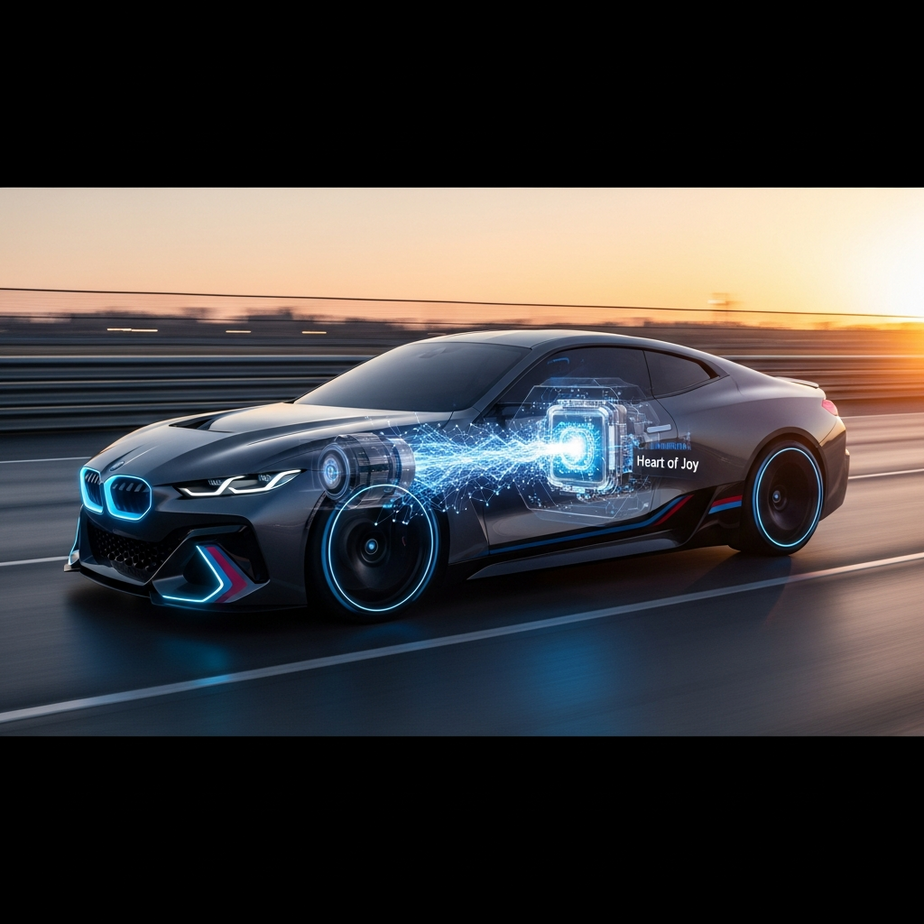
For decades, the BMW M badge has represented the pinnacle of driver engagement, a symbol characterized by roaring inline-six or V8 engines, precise manual gearboxes, and a visceral connection to the road. As the automotive world shifts toward electrification, many enthusiasts have worried that this soul might be lost in the transition to silent battery power. While the German automaker has released potent electric vehicles like the i4 M50 and the massive i7 M70, even insiders at Munich admitted these were not full-blooded M cars. They were fast, certainly, but they lacked the track-hardened DNA that defines the brand’s most legendary models. That is about to change entirely with the introduction of a new technological architecture designed to redefine what a performance car can be. BMW is currently developing its first genuine electric M model, and unlike its predecessors, this vehicle isn’t just relying on raw horsepower to impress. The secret weapon is a centralized computing unit known internally as the Heart of Joy. This super-brain promises to integrate powertrain and chassis dynamics in a way that combustion engines never could, marking a pivotal moment in the history of the ultimate driving machine.
The Difference Between M-Performance and True M Engineering
To understand why this new development is so significant, it is necessary to distinguish between the two tiers of performance vehicles BMW currently produces. On one side, there are the M-Performance models. These are standard road cars that have been tuned for higher output and sportier handling. The i4 M50 is a prime example; it is incredibly quick in a straight line and handles competently, but its underlying architecture is shared with standard commuter sedans. It is designed for spirited street driving rather than punishing lap times at the Nürburgring. On the other side sits the high-performance M division. Historically, cars like the M3 and M5 were re-engineered from the ground up. They featured stiffer chassis bracing, distinct suspension geometries, heavy-duty cooling systems, and engines derived from motorsport programs. For the electric era, BMW knew that simply adding more kilowatt output to a standard electric motor would not be enough to earn the full M badge. The upcoming quad-motor electric M car is being built to bridge this gap. It is not merely a tuned version of an existing electric sedan but a comprehensive reimagining of vehicle dynamics. The engineers are moving away from the limitations of the CLAR platform—which accommodates both gas and electric powertrains—toward the dedicated Neue Klasse architecture. This shift allows for packaging and weight distribution that prioritizes handling above all else, ensuring that the heavy battery packs do not compromise the agility drivers expect from the brand.
Unpacking the Heart of Joy Computer
At the center of this revolution sits a piece of hardware that sounds more like a magical artifact than a car part: the Heart of Joy. In traditional automotive engineering, different systems often operate in silos. The anti-lock braking system has its own controller, the traction control has another, the steering rack has a third, and the engine management system oversees the power delivery. These systems communicate with each other, but there is always a tiny fraction of latency—milliseconds of delay that, while imperceptible to the average commuter, separate a good sports car from a great one. The Heart of Joy changes this paradigm by unifying these distinct functions into a single, integrated software and hardware stack. This centralized unit controls the powertrain and driving dynamics simultaneously. It eliminates the latency caused by different electronic control units trying to talk to one another. Instead, the decision to cut power, apply brakes to a single wheel, or stiffen the damper happens instantly within one processing unit. According to statements made by BMW engineering heads to major automotive outlets, this software stack is a massive undertaking, comprising millions of lines of code. The result is a car that can think faster than the driver can react. If the car detects a loss of traction on an icy patch of tarmac, the Heart of Joy does not need to send a signal from a wheel speed sensor to a brake controller and then to the motor inverter. It simply adjusts the torque instantly. This creates a feeling of absolute fluidity, where the car feels like a direct extension of the driver’s nervous system.
Software as the New Horsepower
In the internal combustion era, engineering dominance was defined by hardware. It was about who could cast the lightest engine block, who could forge the strongest pistons, and who could design the most efficient turbochargers. In the era of the electric M car, software is the new differentiator. Electric motors are relatively simple commodities compared to combustion engines. While there are differences in winding technology and magnet materials, the true performance advantage comes from how those motors are controlled. The Heart of Joy allows BMW to manipulate the delivery of electricity with a granularity that mechanical differentials could never achieve. This means the distinct “personality” of the car is now written in code. BMW can program the car to behave like a rear-wheel-drive drift machine one moment and a grip-focused all-wheel-drive track weapon the next, all without changing a single mechanical part.
Quad-Motor Setup and Infinite Torque Vectoring
The hardware enabling this software wizardry is a quad-motor setup. By placing an individual electric motor at each wheel, BMW unlocks the holy grail of vehicle dynamics: true torque vectoring. Traditional internal combustion cars require heavy, complex mechanical differentials to split power between wheels. Even the best systems are limited by the physical connection of the driveshaft and axles. With four independent motors, the limitations of physics are pushed back. The Heart of Joy can command the front left wheel to regenerate power (braking) while the rear right wheel applies full torque (accelerating). This capability allows the car to pivot around a corner with unnatural agility. It effectively uses the motors to steer the car, reducing the reliance on the steering angle of the front tires. This setup offers distinct advantages for performance driving: – Precision Turn-in: By dragging the inside wheels and powering the outside wheels, the car pulls itself into the apex of a turn.
– Stability Management: In the event of a slide, the computer can micro-adjust the speed of each wheel thousands of times per second to catch the car, often before the driver even realizes they were losing control.
– Tank Turns: While perhaps more of a party trick, a quad-motor setup theoretically allows the vehicle to spin in place, highlighting the independence of each wheel. During early testing of the prototype, widely publicized in teaser videos featuring a modified i4 body, engineers demonstrated the system’s ability to perform controlled drifts on snow and ice with ease. This suggests that the future electric M car will not just be about sterile lap times but will retain the hooligan spirit that made the E92 M3 and F80 M3 so beloved.
The Neue Klasse Architecture Advantage
The Heart of Joy and the quad-motor system will be housed within the Neue Klasse architecture, BMW’s next-generation platform debuting around 2025. This platform is a significant departure from the current strategy of adapting gas-car chassis for EV use. Being an EV-first platform means the engineers can optimize the center of gravity and interior space without working around transmission tunnels or exhaust routing. Crucially, Neue Klasse introduces the sixth generation of BMW’s eDrive technology. This includes new cylindrical battery cells that promise higher energy density and faster charging speeds. For a performance car, this is vital. High-performance driving drains batteries rapidly and generates immense heat. The new 800-volt architecture expected with this platform will allow for better thermal management, ensuring the car can withstand repeated high-speed runs without entering “limp mode,” a common issue in early performance EVs. Furthermore, the packaging of the Neue Klasse allows for a layout that supports the complex cooling requirements of four motors and high-output inverters. The integration of the Heart of Joy into this specific architecture means the computer is not fighting against the chassis; it is woven into it. The suspension mounting points, the battery placement, and the motor positions are all designed to feed accurate physical data back to the central processor.
Preserving the Soul of Driving
The biggest challenge BMW faces is not technical, but emotional. Can a computer called Heart of Joy replace the mechanical feedback of a hydraulic steering rack or the vibration of a gear shift? This is where the subjective art of tuning comes into play. BMW executives have hinted that the goal of this system is not to isolate the driver, but to enhance the feedback loop. Because the system manages the chassis and powertrain together, it can simulate the sensations that drivers love. While it won’t have a gearbox, the precise modulation of torque can create a rhythmic rise and fall in acceleration that mimics a power band. The regeneration can be tuned to provide the same engine braking feel as a high-compression engine dropping a gear. Critics often point to the silence of EVs as a detriment to the experience. However, the absence of engine noise forces engineers to focus on other sensory inputs—tire noise, suspension feedback, and the sensation of G-forces. By removing the latency between the driver’s input and the car’s reaction, the Heart of Joy aims to create a sense of telepathic control. If the car reacts the instant you think about turning, the lack of engine noise becomes secondary to the sheer thrill of the movement.
The Future of Motorsport Tech on the Road
This development also signals a shift in how motorsport influences road cars. In the past, racing technology trickled down in the form of turbochargers, dual-clutch transmissions, and ceramic brakes. Today, the transfer of technology is happening in software algorithms. The traction control systems developed for Formula E are finding their conceptual descendants in the Heart of Joy. By moving to a centralized computer architecture, BMW is also future-proofing its performance division. Over-the-air updates could theoretically unlock new handling profiles or track-specific setups. Imagine arriving at the Laguna Seca raceway and downloading a software patch that optimizes the Heart of Joy specifically for the corkscrew turn, adjusting the torque vectoring logic to handle the elevation drop perfectly. This is the potential reality of the software-defined M car.
A New Chapter for the Ultimate Driving Machine
The transition to electrification is inevitable, but the fear that cars will become appliance-like commodities is being challenged by innovations like the Heart of Joy. BMW is betting that the character of a car is not found solely in the combustion of gasoline, but in the precision of its dynamics and the joy it delivers to the person behind the wheel. By combining a quad-motor layout with a super-computer capable of unifying chassis and powertrain functions, the M division is preparing to launch a vehicle that may be faster and more capable than anything in its storied history. While the roar of the V8 will be missed, the promise of infinite control and instant torque offers a compelling alternative for the next generation of enthusiasts. For those skeptical of the electric future, keeping an eye on how this technology develops is essential. The success of the Heart of Joy will determine if the “Ultimate Driving Machine” slogan can survive the death of the internal combustion engine. If you are interested in the evolution of performance vehicles, now is the time to pay close attention to the prototypes rolling out of Munich. The soul of the sports car isn’t dying; it is simply being recoded.