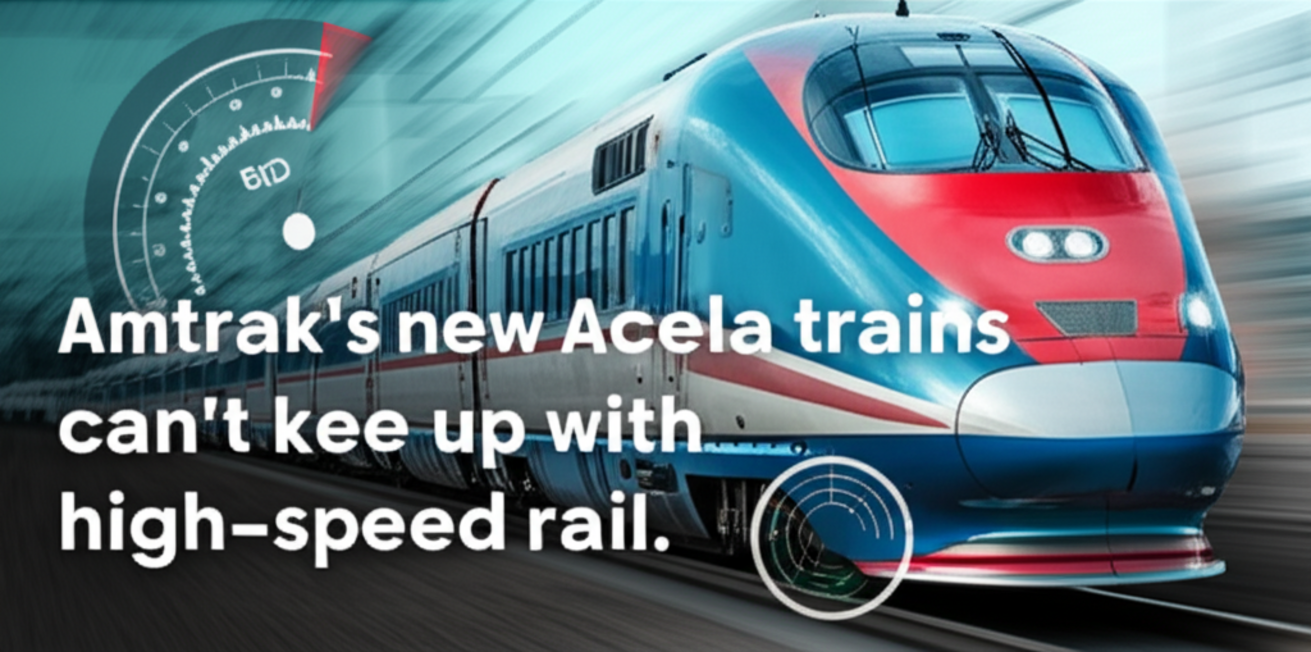
Since the late 1990s, the Northeast Corridor (NEC) has been America’s beating heart of passenger rail, a corridor that carries more people daily than the combined ridership of any other U.S. route. Yet, as Amtrak rolls out its latest generation of Acela trains, the promise of true high‑speed travel remains an elusive dream. While the new NextGen Acela brings a sleeker design, greater capacity, and some operational polish, its speed—measured in miles per hour—has not outpaced the older trains it replaces or the ambitious standards set by railways around the world.
Why Speed Matters—and Why It’s Hard to Achieve
When Amtrak first introduced the Acela in 2000, it marketed the train as the United States’ answer to Europe’s bullet trains. The original units were built to meet the Federal Railroad Administration’s (FRA) stringent crash‑resistance standards, which required the trains to withstand high‑impact collisions without crushing—an approach that forced Amtrak to commission a custom design from a joint venture between Bombardier and Alstom. The result was a heavyweight train that could touch 150 mph on upgraded track but suffered from reliability issues and a reputation for being a “high‑velocity bank vault.”
In contrast, many of Europe’s and Japan’s high‑speed lines operate between 200–300 mph, thanks to lighter, more aerodynamic cars and a different set of safety engineering principles. The FRA’s legacy rules have made it difficult for U.S. manufacturers to adapt proven international designs, creating a technology gap that next‑generation Acela trains are only now beginning to close.
What the New Acela Brings to the Table
Amtrak’s 28 new NextGen Acela sets, built at a factory in Hornell, New York, are longer and carry more passengers—386 seats per set compared to the 304 on the first‑generation train. The new cars feature a modern interior with USB‑C charging ports, power outlets between seats, and upgraded bathroom fixtures. The first‑class cabin continues to offer a “business‑class” experience, but with a single row of seats on one side and a more consistent seat‑pan design that slides forward instead of the older “cradle” style.
In practice, however, the speed gains are marginal. On a typical run from Washington, D.C. to New York City, the NextGen Acela topped out at 144 mph on a straightaway north of Princeton, even though the upgraded track can support 160 mph. By contrast, on a return trip over the same section the train achieved a brief burst of 162 mph, a speed comparable to the French TGV’s 1981 debut but far below the potential of the upgraded corridor.
The Infrastructure Hurdle
Speed isn’t just a function of the train; it’s also a function of the track, electrification, and signaling. The NEC’s original electrification, completed in 1935, relies on a simple overhead wire system that caps speeds at 145 mph. While the corridor’s fastest sections now use constant‑tension catenary—a system that keeps wires taut and reduces sag—the infrastructure remains a patchwork. Large projects such as the $2.2 billion Meadowlands bridge replacement, the $6 billion Baltimore tunnel, and the $14.8 billion Hudson River tunnel upgrade are still under construction, and each one promises to lift speeds and reduce travel times once completed.
Even so, Amtrak is cautious about making concrete speed claims. The railroad’s inspector general has cited ongoing issues with Alstom’s computer modeling of train performance and a series of defects that have delayed testing. The FRA’s testing requirements—still influenced by a “not‑invented‑here” mindset—have forced continuous refinement of the new trains’ simulations and analyses.
Comparing to Global High‑Speed Leaders
Europe’s high‑speed rail network, with lines such as France’s TGV and Germany’s ICE, routinely delivers 300 mph services on purpose‑built tracks. Japan’s Shinkansen, with its 320 mph flagship, demonstrates how advanced signaling, precise track geometry, and dedicated rights‑of‑way can combine to create a truly high‑speed experience. The United States, by comparison, still relies on shared freight corridors, legacy signaling systems, and a fragmented regulatory environment that stifles rapid deployment.
Amtrak’s vision is to upgrade the NEC to an international standard, but the process is incremental. Upgrades to electrification and catenary are happening piece‑by‑piece, and the focus has largely been on reliability and safety rather than outright speed. While the new Acela’s interior comforts and increased capacity are welcome, they don’t address the core issue: the corridor’s inability to support sustained speeds above 160 mph over long distances.
Future Possibilities: From Hyperloop to Magnetic Levitation
Public imagination is increasingly drawn to futuristic concepts such as maglev trains or Elon Musk’s hyperloop. While these ideas promise dramatic speed improvements—some claim over 500 mph—they remain largely theoretical, expensive, and unproven at scale. In contrast, proven steel‑wheel‑on‑steel‑rail technology has already been demonstrated in countries like China, where high‑speed lines regularly exceed 200 mph on dedicated tracks.
California’s ambitious high‑speed rail project, for instance, has seen its cost estimates balloon to $87 billion with a projected service start in 2038. Even if the project adopts international construction standards, it still faces significant funding challenges and a protracted permitting process. Brightline West, a newer venture to connect Los Angeles to Las Vegas, offers a more modest route but still struggles with financing and rising construction costs.
What It Means for Amtrak Riders
For the average passenger, the differences between the old and new Acela are subtle: a cleaner exterior, more reliable power outlets, and a slightly smoother ride. Yet the core promise of high‑speed travel—reaching Boston in under two hours from Washington—remains unmet. Even with the addition of constant‑tension catenary and new tunnel projects, Amtrak’s forecasts are conservative, stating that faster trip times will “be determined based on infrastructure improvements” without giving a clear timetable.
While the NEC will continue to be the United States’ only high‑speed rail corridor for the foreseeable future, the gap between it and the world’s fastest lines widens. To truly close that gap, the federal government and the states must move beyond incremental upgrades and embrace a more unified, international‑standard approach to track design, signaling, and procurement. Only then can the next generation of Acela trains—and potentially a new wave of high‑speed services—deliver on the promise of speed and efficiency that many riders and policymakers have long desired.