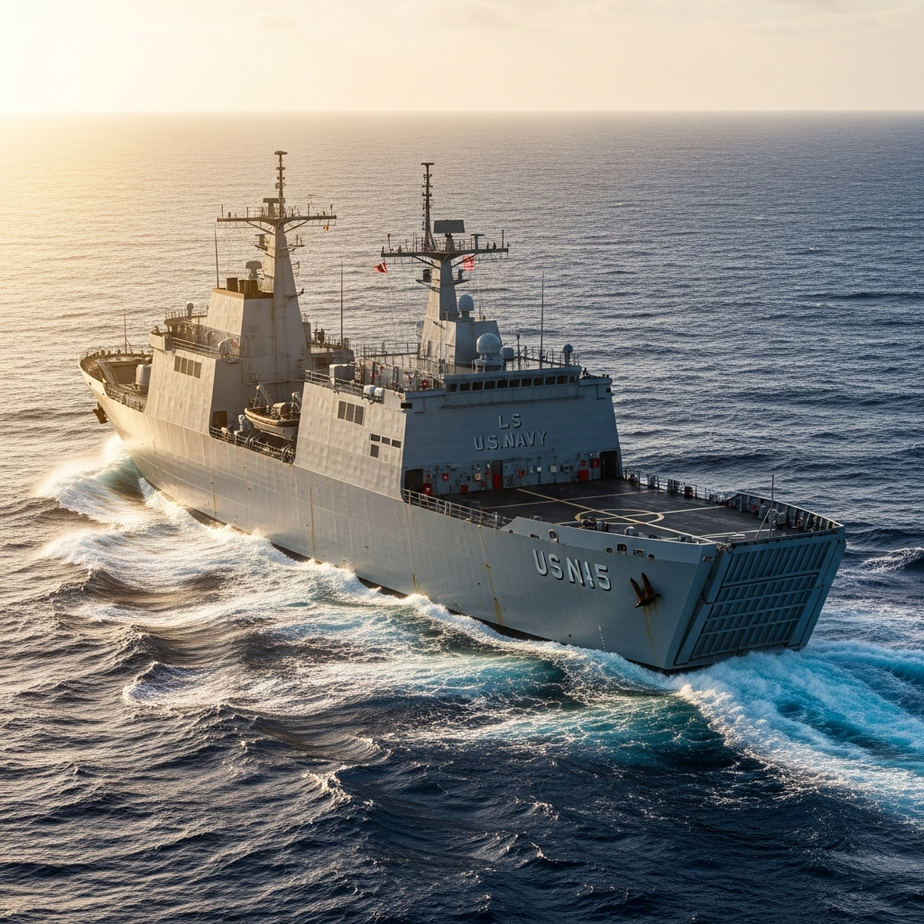
The changing landscape of modern naval warfare has forced the United States military to rethink how it moves troops across vast oceans. In a significant departure from traditional acquisition strategies, the U.S. Navy is betting on a foreign design for its new Medium Landing Ship to modernize its amphibious capabilities. This decision marks a pivotal shift toward pragmatism, prioritizing speed of delivery and proven engineering over the often lengthy and expensive process of developing entirely new domestic designs from scratch. By leveraging an existing hull form from an allied nation, the Navy aims to bypass the technical hurdles that have plagued recent shipbuilding programs, ensuring that the Marine Corps gets the transport capacity it needs for the Pacific theater without breaking the budget.
The Strategic Necessity of the Medium Landing Ship
To understand why the Navy is looking abroad for this specific vessel, one must first understand the changing strategy of the U.S. Marine Corps. Under the doctrine known as Force Design 2030, the Marines are shifting away from massive, heavy land campaigns and returning to their naval roots. The goal is to create small, mobile units capable of hopping from island to island in contested waters, a strategy formally referred to as Expeditionary Advanced Base Operations. Traditional amphibious assault ships are massive, expensive, and potent, but they are also large targets. In a conflict with a near-peer adversary equipped with long-range precision missiles, concentrating thousands of Marines on a single large vessel creates an unacceptable risk. The solution is dispersion. The Navy needs a fleet of smaller, more agile ships that can blend in with commercial traffic, land directly on beaches, and offload equipment quickly before moving to the next location. This is where the Medium Landing Ship, formerly known as the Light Amphibious Warship, comes into play. It fills the gap between the massive “big deck” amphibs and the smaller ship-to-shore connectors. It is designed to be the workhorse of this new distributed strategy, carrying roughly 75 Marines and their vehicles over thousands of miles of open ocean.
Why the Navy Is Choosing a Foreign Design
The decision to utilize a foreign design for the Medium Landing Ship is driven primarily by the urgent need to control costs and adhere to strict timelines. In recent decades, U.S. naval shipbuilding has struggled with “requirements creep,” where the military adds so many custom specifications to a new ship class that the price balloons and production falls years behind schedule. By adopting a “parent design” approach, the Navy is selecting a vessel that already exists and functions effectively. Instead of drawing a ship on a blank sheet of paper, they are taking a proven commercial or foreign military hull and modifying it to meet U.S. specifications. This strategy significantly reduces technological risk. Engineers already know the ship floats, is stable in rough seas, and operates efficiently. This approach is not entirely without precedent, but it is becoming increasingly vital. The Navy acknowledges that allied nations, particularly those with robust commercial shipbuilding industries, have perfected designs for stern-landing vessels and shallow-draft ferries that perfectly mimic the requirements of the Medium Landing Ship. Adopting these designs allows the U.S. to skip the prototyping phase and move directly into production engineering.
The Role of Allied Shipbuilders
The specific design likely stems from Australian commercial shipbuilding expertise, which is renowned for producing rugged, high-speed ferries and support vessels. Australian shipbuilders have long serviced the resource and tourism sectors with vessels capable of beaching in remote locations—exactly the capability the U.S. Marines require. While the design is foreign, the construction will remain domestic. To comply with U.S. law, specifically the Jones Act and various defense acquisition regulations, the ships must be built in American shipyards. This creates a hybrid model where foreign intellectual property and naval architecture are transferred to U.S. facilities, allowing the Navy to benefit from international innovation while supporting the American industrial base.
Technical Capabilities and Operational Profile
The Medium Landing Ship is distinct from any other vessel currently in the U.S. fleet. It is not designed to fight for sea control with missiles and heavy guns. Instead, its primary weapon is logistics—the ability to put Marines where the adversary does not expect them. The vessel is expected to range between 200 and 400 feet in length. Its defining feature is likely to be a stern landing ramp. Unlike World War II-era landing ships that opened at the bow, modern stern landing vessels allow the ship to push its rear onto a beach or improved shoreline. This protects the propellers and rudders, which remain in deeper water, and allows the ship to extract itself more easily from the shore.
Key specifications typically include:
– A range of over 3,500 nautical miles without refueling, allowing for trans-Pacific operations.
– A shallow draft generally under 12 feet, enabling access to small ports and undeveloped beaches that large destroyers or amphibious ships cannot approach.
– A cargo deck capable of holding heavy rolling stock, such as the Marines’ new Amphibious Combat Vehicles or mobile missile launchers.
– Habitability standards suitable for keeping a platoon of Marines fresh and ready for combat after weeks at sea. These ships are intended to operate in groups, creating a difficult targeting problem for adversaries. If the Navy builds enough of them—the target is currently between 18 and 35 vessels—they can saturate a combat zone, making it impossible for an enemy to track every potential landing force.
Addressing Cost Overruns and Production Delays
The primary driver behind the foreign design choice is the budget. The Navy has set a strict cost cap for these vessels, aiming for a price point significantly lower than a typical warship. Estimates have fluctuated, but the goal is to keep the cost per ship under $150 million to $180 million. For context, a standard amphibious transport dock can cost nearly $2 billion. To achieve this, the Navy is accepting “commercial standards” for many parts of the ship. This means the Medium Landing Ship will not be built with the same level of redundant survivability systems found on a destroyer. It may not have the same shock-hardened hull or advanced radar suites. It is built to commercial maritime standards with specific military modifications. This tradeoff is intentional. The philosophy is that it is better to have more ships that are “good enough” rather than a handful of “perfect” ships that are too expensive to lose. By using a foreign design that utilizes standard commercial parts, the Navy also simplifies the supply chain. If an engine part breaks in a remote port, it might be a standard commercial diesel component rather than a custom-milled piece of military hardware.
Challenges and Criticisms of the Strategy
Despite the logical reasoning behind betting on a foreign design, the program faces skepticism. Critics within the defense community argue that relying on commercial standards for a warship operating in a contested zone is dangerous. They worry that these ships, lacking heavy armor and defensive weaponry, will be easy prey for anti-ship missiles or aircraft. There is also the challenge of modification. History has shown that even when the U.S. military buys a “off-the-shelf” product, the urge to customize it can ruin the efficiency of the purchase. If the Navy insists on adding too many proprietary communications systems, weapons mounts, or unique safety features, the cost savings of the foreign design could evaporate, leaving the service with an expensive hybrid that excels at neither commercial efficiency nor military survivability. Furthermore, speed is a point of contention. Commercial stern landing vessels are generally slower than dedicated warships. In a fast-moving conflict in the Pacific, the ability to outrun weather or reposition quickly is vital. The Navy must ensure that the chosen propulsion system provides enough power to keep up with the operational tempo of the fleet.
The Future of American Amphibious Shipbuilding
The success or failure of the Medium Landing Ship program will have lasting implications for how the United States acquires military hardware. If this program succeeds—delivering ships on time and on budget by using a foreign parent design—it could become a model for future auxiliary and support vessels. This approach signals a humbling but necessary realization: the U.S. does not hold a monopoly on good naval architecture. Allies in Europe and the Indo-Pacific often innovate faster in the small-ship market because their navies rely on them more heavily. By swallowing its pride and purchasing a license for a foreign design, the U.S. Navy is demonstrating a focus on outcomes rather than origins. Industry experts note that this partnership also strengthens alliances. By validating the design of an allied nation, the U.S. improves interoperability. If American and Australian forces are operating similar classes of ships, they can share parts, maintenance facilities, and operational tactics more seamlessly.
What to Watch For Next
As the program moves from design selection to steel cutting, observers should watch the shipyard selection process closely. The integration of foreign technical data into U.S. shipyard workflows is complex. The chosen shipbuilder will need to demonstrate that they can translate the foreign plans into a vessel that meets U.S. Coast Guard and Navy regulations without requiring a total redesign. Additionally, the Marine Corps will soon begin testing the operational concepts associated with these ships. As the first hulls hit the water, we will see if the theory of “Stand-in Forces”—small units operating within the enemy’s weapons engagement zone—is viable with this class of ship.
Navigating Toward a Modern Fleet
The U.S. Navy’s decision to adopt a foreign design for the Medium Landing Ship represents a calculated risk that prioritizes practical capability over protectionist tradition. It is a recognition that in the modern era of great power competition, time and money are resources as critical as steel and fuel. By leaning on the proven engineering of allied partners, the Navy hopes to deliver a fleet of agile, beach-capable transports that can support the Marine Corps’ vision of island-hopping warfare. While challenges regarding survivability and modification restraint remain, the path forward is clear. The future of amphibious warfare is not just about the biggest ship on the water; it is about the right ship for the mission. The Medium Landing Ship aims to be exactly that, proving that sometimes the best way to build the future force is to borrow what already works today. For those interested in the evolution of naval strategy and defense procurement, keeping an eye on the execution of this program offers a fascinating case study in military modernization. As construction begins, the true test will be whether the bureaucracy can resist the urge to over-complicate a simple, effective design. The ocean is waiting, and the timeline for readiness is tightening.