The Core Workout Rut: Why Your Abs Routine Isn’t Working
Let’s be honest: the traditional core workout is broken. For years, we’ve been told that the path to a strong, stable midsection is paved with hundreds of sit-ups and endless planks. But if you’re like me, you’ve probably discovered that this path often leads to a plateau, boredom, and even a nagging lower back. I was stuck in this exact cycle, performing the same static exercises day after day, wondering why my functional strength wasn’t improving. That’s when I decided to look for a smarter, more dynamic approach and discovered the **sprinter bridge**.
This single exercise completely changed my perspective on core training. It’s a powerful movement that challenges your body in a way that crunches and sit-ups simply can’t, targeting not just the abs but the entire system of muscles responsible for stability and power.
The Problem with Sit-Ups and Crunches
The classic sit-up is an image seared into our collective fitness memory. Yet, modern exercise science has largely moved away from it, and for good reason. The repetitive spinal flexion involved in a sit-up can place significant strain on your lumbar spine. A study published by the American Council on Exercise even highlighted how exercises like crunches are less effective at activating core musculature compared to more integrated movements.
Furthermore, sit-ups primarily target the rectus abdominis—the “six-pack” muscles—while neglecting the deeper core muscles and the posterior chain (the muscles on the backside of your body). This creates an imbalance, where the front of your body becomes tight and strong while the back remains weak, a common recipe for poor posture and lower back pain.
The Plateau of the Plank
The plank is undeniably a better option than the sit-up. It’s an isometric exercise that forces you to engage your entire core to resist gravity and maintain a neutral spine. It’s a fantastic foundational move for building endurance in your midsection.
However, its static nature is also its biggest limitation. Life is not static; we move, twist, run, and lift. A truly functional core needs to be strong through a range of motion. Relying solely on planks means you’re training your core to be a rigid pillar but not a dynamic powerhouse capable of transferring force efficiently. This is where the **sprinter bridge** enters the picture as a superior technological advancement in bodyweight training.
What is the Sprinter Bridge and Why is it So Effective?
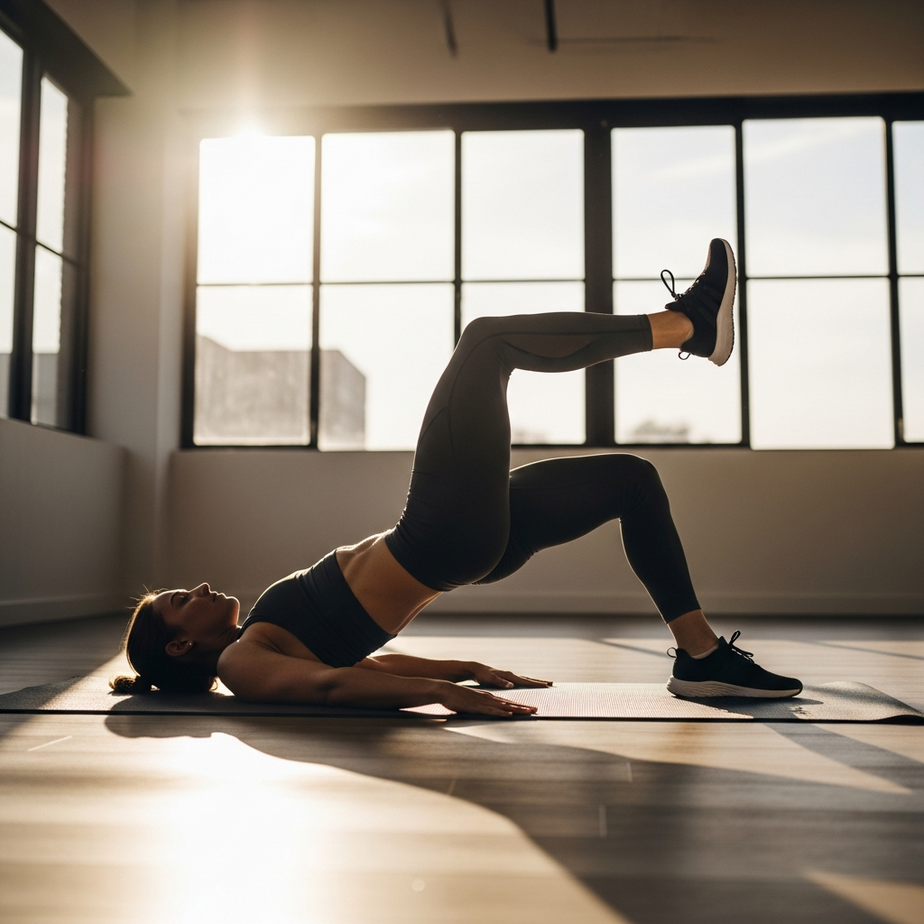
The **sprinter bridge** looks like a combination of a glute bridge and a running motion, and that’s essentially what it is. It’s a dynamic exercise that builds strength, stability, and coordination simultaneously. Unlike static holds, it challenges your core to stabilize against movement, mimicking the demands of real-world activities like running, jumping, and lifting.
This exercise is a perfect example of how a simple shift in technique—the “technology” of movement—can yield far greater results. It transforms a basic hip extension into a full-body exercise that integrates the glutes, hamstrings, lower back, and obliques into a single, fluid motion.
Deconstructing the Movement: How to Perform a Perfect Sprinter Bridge
Getting the form right is crucial to maximizing the benefits and preventing injury. It might feel a little uncoordinated at first, but with a few practice reps, the rhythm will click.
Follow these steps:
1. Lie on your back with your knees bent and your feet flat on the floor, about hip-width apart. Your arms should be resting by your sides with your palms down.
2. Press through your heels to lift your hips off the floor, engaging your glutes and hamstrings. Your body should form a straight line from your shoulders to your knees. This is the starting glute bridge position.
3. Once you are stable, drive your right knee up towards your chest. As you do this, bring your left arm forward in a running motion, keeping your elbow bent at a 90-degree angle. Your right arm should simultaneously move backward.
4. The key is to keep your hips level and high. Your core must work overtime to prevent your pelvis from tilting or dropping as you move your arm and leg.
5. Lower your right foot back to the floor with control and return your arms to the starting position.
6. Immediately repeat the movement on the other side, driving your left knee up and your right arm forward. This completes one repetition.
The Muscles You’re Actually Working
The beauty of the **sprinter bridge** lies in its comprehensive muscle activation. It’s far more than just an “ab exercise.”
Here’s a breakdown of what gets fired up:
– Gluteus Maximus: This is the primary mover responsible for lifting your hips. Strong glutes are essential for power, posture, and preventing lower back pain.
– Hamstrings: These muscles work alongside the glutes to extend the hips and also help stabilize the knee.
– Erector Spinae: These are the muscles running along your spine. They work isometrically to keep your back straight and prevent your hips from sagging.
– Obliques: Your internal and external obliques are the anti-rotation powerhouses. They fire intensely to stop your torso from twisting as you drive your knee up.
– Rectus Abdominis: While not the primary target, your “six-pack” muscles engage to help stabilize your pelvis and assist in the knee drive.
My 30-Day Sprinter Bridge Experiment: The Setup and The Goal
Tired of my stale routine, I committed to a 30-day experiment. I decided to completely replace sit-ups, crunches, and leg raises with the **sprinter bridge**. My goal was twofold: first, to see if I could feel a tangible difference in my core stability and functional strength, and second, to break the sheer monotony of my existing workout.
I wanted to do more than just “feel” the difference; I wanted to track it. This is where a little bit of modern technology came into play, helping me quantify the experience.
My Starting Point and The Technology I Used
Before starting, my core routine was predictable: 3 sets of 20 sit-ups and 3 sets of 60-second planks, three times a week. I felt competent at these exercises but wasn’t seeing any real-world carryover. My lower back would often feel tight after a long run, and I felt a general lack of “connectedness” between my upper and lower body during compound lifts.
To track my progress, I used a simple fitness app on my smartphone to log every session. I recorded:
– The number of sets and reps performed.
– A rating from 1 to 5 on how stable I felt.
– Any notes on muscle soreness or form challenges.
I also wore my smartwatch during each workout. While not essential for the exercise itself, monitoring my heart rate helped me gauge the cardiovascular demand of the **sprinter bridge** compared to my old, slower-paced core work.
The Weekly Routine: How I Integrated the Sprinter Bridge
My plan was simple and sustainable. I incorporated the exercise into my existing workout schedule three times per week.
My starting routine was:
– 3 sets of 10 repetitions per side (20 total reps per set).
– 60 seconds of rest between each set.
The focus was on perfect form over speed. I aimed to control the movement, keeping my hips high and steady throughout each and every rep. This deliberate, controlled approach is what makes the **sprinter bridge** so challenging and effective.
The Surprising Results: What Happened After 30 Days
The first week was a lesson in humility. The following month was a revelation. The difference this single exercise made was more significant than I could have imagined, impacting not just my core but my overall athletic performance.
Week 1: The Awkward Learning Curve
My first attempt at the **sprinter bridge** was clumsy. My hips wanted to drop with every knee drive, and coordinating the opposite arm and leg movement felt like patting my head while rubbing my stomach. I had to significantly slow down and focus intently on keeping my glutes squeezed and my core braced.
By the end of the first week, I was sore in places I didn’t expect—deep in my obliques and high in my hamstrings. This was a clear sign that the exercise was hitting neglected muscles. My stability rating in my app was a wobbly 2 out of 5, but I was determined to improve.
Week 2: Finding the Rhythm and Feeling the Burn
In the second week, something clicked. The contralateral movement (opposite arm, opposite leg) started to feel natural. I could perform the reps more smoothly without my hips swaying. My focus shifted from just completing the reps to really *feeling* the connection between my glutes and my deep abdominal muscles.
My heart rate data showed a noticeable spike during the sets, confirming that this dynamic movement was far more metabolically demanding than a static plank. The post-workout “burn” felt deeper and more satisfying. My stability rating jumped to a 4 out of 5.
Week 3 & 4: Noticeable Gains in Stability and Power
This is where the real magic happened. By the third week, I was able to increase my volume to 3 sets of 15 reps per side. The movement felt powerful and controlled. But the most significant changes were noticeable outside of my core workouts.
– During my runs, I felt more stable and upright, especially when fatigued. That nagging lower back tightness began to disappear.
– In the gym, my deadlifts and squats felt stronger. I could brace my core more effectively, creating a solid foundation to lift heavier weight.
– Even simple daily activities, like carrying groceries or lifting a box, felt easier and more secure.
The **sprinter bridge** wasn’t just building my abs; it was building a truly functional and integrated core. It was teaching my body to work as a cohesive unit, which is the true definition of functional strength.
How to Add the Sprinter Bridge to Your Own Routine
Convinced? Adding this exercise to your routine is simple, but it’s important to start correctly to build a strong foundation. Whether you’re a complete beginner or an advanced athlete, the **sprinter bridge** can be scaled to meet you where you are.
Beginner Modifications and Common Mistakes to Avoid
If you’re new to the movement, don’t rush. The goal is quality over quantity.
– Start with a regular glute bridge: Before adding the “sprint” component, make sure you can hold a solid glute bridge for 30–60 seconds with your hips high and level.
– Slow it down: Perform the knee drive and arm swing very slowly and deliberately. You can even pause for a second at the top of the movement to check your hip alignment.
– Master the form first: Begin with just 2 sets of 8 reps per side and focus on flawless execution.
Avoid these common mistakes:
– Dropping your hips: This is the most common error. Actively squeeze your glutes throughout the entire set to keep your hips elevated.
– Arching your back: Don’t overextend your lower back at the top. Your body should be in a straight line, not a U-shape.
– Rushing the reps: Using momentum robs you of the stability benefits. Control is the name of the game.
Advanced Variations for a Greater Challenge
Once you’ve mastered the standard **sprinter bridge** and can comfortably perform 3 sets of 15-20 reps per side, you can increase the difficulty with these variations:
– Add a resistance band: Place a mini-band around your thighs, just above your knees. This will force your gluteus medius to work harder to keep your knees from collapsing inward.
– Elevate your foot: Place your non-working foot on a low box or step to increase the range of motion and demand on the stabilizing leg.
– Add weight: Hold a dumbbell or kettlebell across your hips to increase the load on your glutes and hamstrings.
Swapping out my tired old core exercises for the dynamic **sprinter bridge** was one of the best decisions I’ve made for my fitness. It proved that smarter training, not just harder training, is the key to breaking through plateaus. This single movement strengthened my entire posterior chain, improved my real-world stability, and made my workouts more engaging.
If you feel stuck in a core training rut, I challenge you to do the same. Ditch the endless crunches for just 30 days and introduce this powerful exercise into your routine. You won’t just build a stronger core; you’ll build a more resilient, capable, and connected body. Explore more dynamic movements like this one and discover how the right exercise technology can fundamentally change your results.