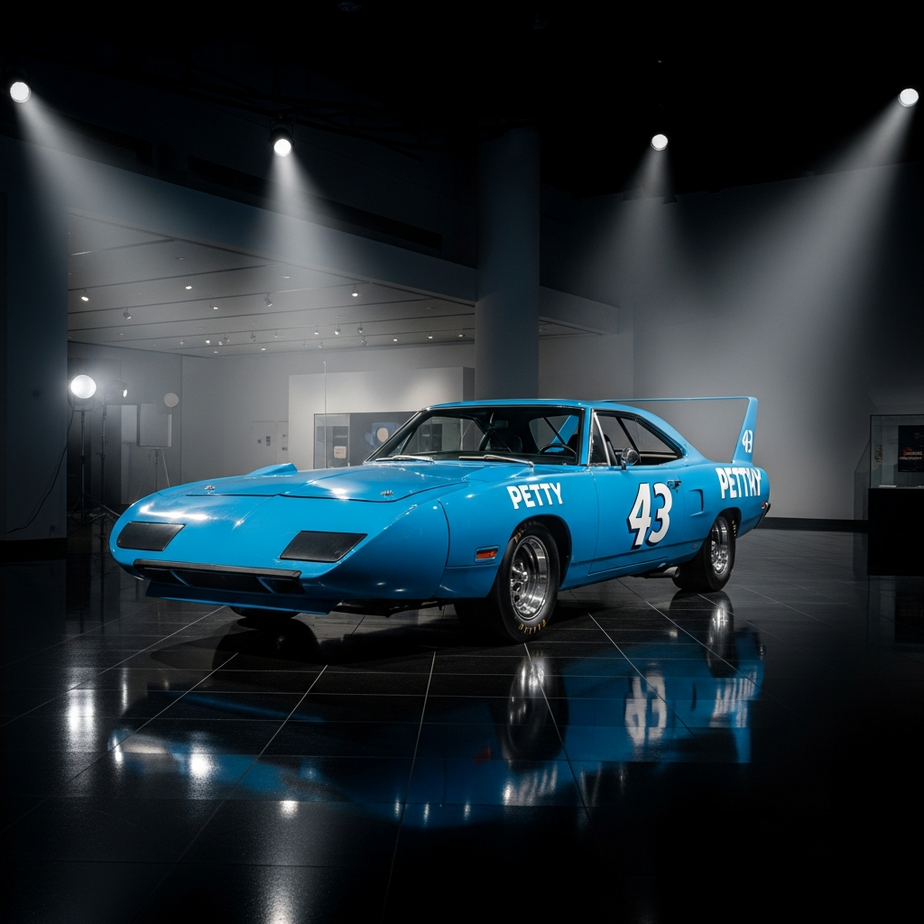
The Legend of the Winged Warrior: More Than Just a Car
Few cars command attention quite like the 1970 Plymouth Superbird. With its colossal rear wing, aerodynamic nose cone, and unmistakable profile, it was a machine built for one purpose: to dominate NASCAR. In the late 1960s, the battle for supremacy on the superspeedways was raging, a period now famously known as the “Aero Wars.” Ford had its Torino Talladega, and Dodge had its Charger Daytona. Plymouth needed an answer, and that answer was the Superbird.
The creation of the Superbird was a strategic move to lure their star driver, Richard Petty, back from Ford. Petty, known as “The King,” had left Plymouth for the 1969 season, and getting him back was paramount. The Superbird, based on the Road Runner, was the ultimate peace offering. It was a radical, homologation special, meaning Plymouth had to produce a certain number for public sale to make it legal for racing.
Under the hood, these winged warriors were often equipped with the formidable 426 cubic-inch HEMI V8, an engine that produced a sound as intimidating as the car’s appearance. The engineering was extreme for its time. The nose cone added 19 inches to the car’s length, and the iconic rear wing was mounted on tall vertical struts to reach “clean air” above the roofline for maximum downforce. It was this combination of raw power and groundbreaking aerodynamics that made the car a legend.
In the 1970 season, Richard Petty and his Petty Blue #43 Superbird were a force to be reckoned with. They secured 18 wins and numerous top-ten finishes, solidifying both Petty’s legacy and the Superbird’s place in motorsport history. The car wasn’t just a vehicle; it was a symbol of an era when rules were few, and innovation was everything.
A Tale of Two Superbirds: The Real vs. The Famed
When discussing the fate of Richard Petty’s iconic car, a critical distinction must be made. The question “Here’s Where Richard Petty’s Legendary Plymouth Superbird Is Today” is complicated because there isn’t just one car. There is the actual race car he drove in 1970 and a separate, highly famous street-legal Superbird that has its own incredible story.
The Original #43 Race Car: A Ghost of the Track
The journey of the genuine, track-pounded #43 Superbird that Richard Petty piloted during the 1970 NASCAR season is shrouded in the typical mystery of vintage race cars. In that era, race cars were tools, not museum pieces. They were built, raced, wrecked, repaired, and often cannibalized for parts for the next season’s car.
After the 1970 season, NASCAR effectively banned the Aero Cars by imposing engine restrictions that made them uncompetitive. As a result, the Superbirds and Daytonas vanished from the track. The original Petty race car was likely re-bodied into a 1971 Road Runner or Charger to comply with new regulations. Its unique Superbird components would have been stripped away, and the chassis would have continued its life on the track in a new form.
Experts and historians believe that no single, complete, and untouched #43 Superbird race car from that season exists today. Its parts and soul were likely scattered across several subsequent Petty race cars, making it impossible to point to one vehicle and declare it the definitive original.
The Famed “Street” Superbird: The Mecum Auction Star
While the race car’s fate is uncertain, a different, equally significant car has captured the public’s imagination. This is the vehicle most people think of when they ask, “Here’s Where Richard Petty’s Legendary Plymouth Superbird Is Today.” It is a genuine 1970 Plymouth Superbird, factory-built with a 426 HEMI and a four-speed manual transmission, but it was not a race car.
This car is widely believed to have been a special promotional vehicle used by Petty or a gift from Chrysler. It has been meticulously restored to its former glory, finished in iconic Petty Blue paint and featuring a black vinyl top—a feature the race cars never had. Its well-documented history and direct connection to “The King” make it an automotive celebrity in its own right.
This specific Superbird became a global sensation when it crossed the auction block at Mecum Auctions. It represents the most tangible, publicly known link to Petty’s time with the winged warrior. Its journey through different collectors’ hands and its recent high-profile sale are central to understanding where this piece of history resides.
From Racetrack Legend to Auction Block Royalty
The story of Richard Petty’s road-going Superbird reached a new chapter when it became a star attraction at major collector car auctions. This vehicle, verified and documented as having ties to the Petty family, represents a unique piece of automotive heritage, blending the raw DNA of a race-bred machine with the finish of a street car.
Its most recent and notable appearance was at the Mecum Kissimmee auction in January 2022. The car was presented in concours-quality condition, having undergone a painstaking restoration that brought it back to factory-fresh specifications. It boasts the legendary 426 HEMI V8 engine paired with a four-speed manual transmission and a Dana 60 rear end—the most desirable combination for any Mopar enthusiast.
The auction created a massive buzz in the collector community. Bidding was fierce, reflecting the car’s unparalleled provenance. Ultimately, the car sold for a staggering $1.65 million. This price tag underscores the immense value placed on vehicles with a direct connection to motorsport royalty like Richard Petty. The identity of the new owner remains private, a common practice for high-profile acquisitions. So, the direct answer to “Here’s Where Richard Petty’s Legendary Plymouth Superbird Is Today” is that it now rests in a prestigious private collection, its value and legend having been solidified on the world’s stage.
The car’s value is driven by several key factors:
– Celebrity Provenance: Its direct link to Richard Petty is the single most important factor.
– Rarity: Fewer than 2,000 Superbirds were ever made, and HEMI four-speed examples are the rarest of all.
– Desirability: The Superbird’s radical design and racing pedigree make it one of the most iconic muscle cars ever produced.
– Condition: A professional, nut-and-bolt restoration ensures it is a museum-quality example.
This sale proves that the legend of the Superbird is not just about nostalgia; it’s a blue-chip asset in the world of collector cars.
Why the Plymouth Superbird Still Captivates Collectors
Decades after it last turned a wheel in anger on a NASCAR track, the Plymouth Superbird continues to hold a special place in the hearts of car enthusiasts and collectors worldwide. Its appeal transcends mere mechanics and performance figures; it’s a cultural icon that represents a unique moment in American history.
A Symbol of an Unrestricted Era
The Superbird is the embodiment of a “win on Sunday, sell on Monday” philosophy pushed to its absolute extreme. It hails from a time when automotive engineers were given free rein to innovate, bending rules and pushing boundaries to gain a competitive edge. The car’s outlandish wing and nose cone would never be approved for a production vehicle today, making it a rolling testament to a bygone era of ambition and audacity.
This unrestricted spirit is a major part of its allure. Collectors don’t just see a car; they see the pinnacle of the muscle car era, a time when Detroit’s Big Three were locked in a spectacular technological arms race. The Superbird is a symbol of American ingenuity and the relentless pursuit of victory.
Rarity and Pop Culture Impact
With production numbers estimated to be just over 1,900 units to meet homologation requirements, the Superbird was rare from the day it was built. Finding one in any condition is a challenge, and pristine, well-documented examples—especially those with a HEMI engine—are among the most coveted muscle cars on the planet.
Furthermore, the Superbird has been immortalized in popular culture. Its most famous role came in the 2006 Disney/Pixar film *Cars*, where the character Strip “The King” Weathers is a direct tribute to Richard Petty’s #43 Superbird. This introduced the car’s iconic shape and story to a whole new generation, cementing its status as a timeless classic. The constant search for information about “Here’s Where Richard Petty’s Legendary Plymouth Superbird Is Today” is a testament to its enduring fame.
Identifying a Genuine Superbird: A Collector’s Guide
For those dreaming of owning a piece of this history, distinguishing a genuine Superbird from a clone or tribute car is paramount. The high value of these vehicles has led to many convincing replicas being built from standard Plymouth Road Runners or Satellites. A thorough inspection and verification are crucial.
Here are some key identifiers for a real 1970 Plymouth Superbird:
1. Vehicle Identification Number (VIN): A genuine Superbird VIN will start with the sequence “RM23.” The “R” designates the Belvedere/Satellite line, “M” stands for “Medium” price class (Road Runner), and “23” is the code for a 2-door hardtop.
2. The Engine Code: The fifth character in the VIN indicates the original engine. A “U” code signifies a 440 cubic-inch 4-barrel engine, an “V” code represents the 440 6-barrel, and the holy grail “R” code denotes the 426 HEMI.
3. Fender Tag and Build Sheet: These documents contain the car’s original production codes, including paint, interior, engine, and transmission options. A critical code to look for is “V19,” which signifies the special black vinyl top that was mandatory on all Superbirds. The build sheet is often found hidden under the rear seat or on top of the glove box and is considered the car’s birth certificate.
4. Unique Body Modifications: Genuine Superbirds have specific structural modifications that are difficult to replicate perfectly. This includes the special flush-mounted rear window “plug,” the steel nose cone with its intricate bracing, and the reinforced trunk floor to support the massive wing. According to sources like the National Automobile Dealers Association (NADA) guides, documented originality is a key driver of value.
Verifying provenance is just as important as physical inspection. Tracing ownership history and cross-referencing documentation can confirm a car’s authenticity and story. For a car with a history as significant as the one tied to Richard Petty, this documentation is what elevates it from a valuable classic to a priceless piece of automotive lore.
The story of Richard Petty’s Superbird is a fascinating blend of racing history, mechanical artistry, and collector passion. While the original race car is likely lost to time, its spirit lives on in the magnificent HEMI-powered street version that continues to break records at auction. This car, now residing in a private collection, serves as a physical reminder of The King’s dominance and the audacious engineering of the Aero Wars.
The Superbird represents more than just a car; it’s a symbol of a golden age in American motorsports, a time of unparalleled innovation and fierce competition. Its legacy is preserved not only in museums and private garages but also in the imaginations of enthusiasts who still marvel at its radical design. The enduring quest to know “Here’s Where Richard Petty’s Legendary Plymouth Superbird Is Today” ensures its story will be told for generations to come.
Are you captivated by the icons of the muscle car era? Explore our extensive galleries and articles to discover more about the legendary machines that defined a generation of American power and style.