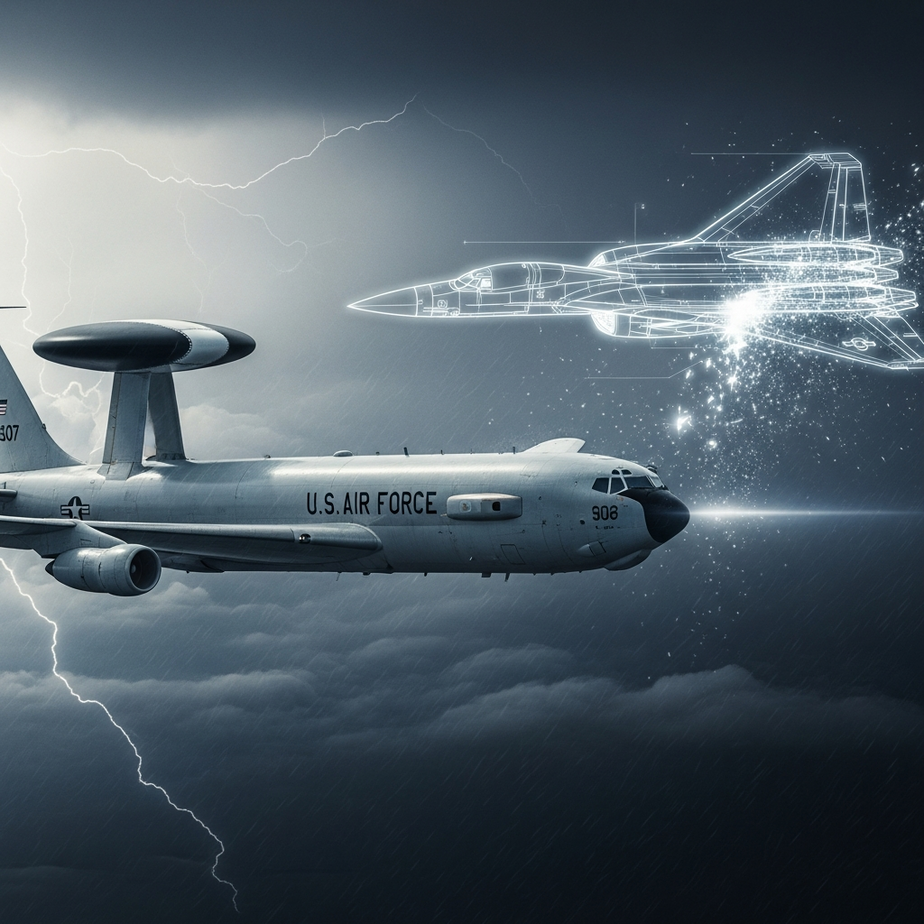
For decades, the silhouette of a massive aircraft topped with a rotating saucer has been the ultimate symbol of American air superiority. This iconic image represents the E-3 Sentry, the airborne warning and control system that has served as the eyes and ears of the Air Force since the late 1970s. However, time has not been kind to these Cold War-era giants, and the urgent push to modernize the US military’s radar planes is facing significant turbulence. While the plan seemed straightforward on paper—retire the aging fleet and bring in a modern, digital successor—the reality has been marred by contract disputes, rising costs, and production delays. The situation has evolved into a high-stakes race against time. As the current fleet becomes increasingly difficult to keep in the air, the gap between the retirement of the old guard and the arrival of the new fleet is widening. This transition is not merely a logistical headache; it represents a potential vulnerability in national defense. If the replacement program continues to slip, the military could face a period where its ability to monitor battlefields and manage air combat is severely compromised. Understanding why this process has gone off the rails requires looking at the history of the aircraft, the promise of its successor, and the complex industrial challenges slowing everything down.
The Legacy of the E-3 Sentry and Why It Must Go
To understand the gravity of the current delays, you have to appreciate what the E-3 Sentry actually does. Often referred to as AWACS (Airborne Warning and Control System), these modified Boeing 707s are essentially flying air traffic control towers combined with long-range surveillance radars. In a conflict, they do not just watch the sky; they manage the entire battle. They spot enemy aircraft from hundreds of miles away, direct friendly fighters to their targets, and coordinate search and rescue missions. For nearly half a century, no major US air operation has taken place without an E-3 circling overhead. However, the platform is undeniably a relic of a different era. The airframes are based on commercial airliners that ceased production decades ago. This means that every time a part breaks, it is increasingly difficult to find a replacement. Maintainers often have to scavenge parts from “boneyard” aircraft or have them custom-manufactured at great expense. The mission capability rates—the percentage of time the aircraft are actually ready to fly—have plummeted. Furthermore, the technology inside the dome is becoming obsolete. While the radar was revolutionary in the 1970s, modern warfare has shifted toward stealth technology, electronic warfare, and hypersonic missiles. The E-3’s mechanical radar, which physically rotates to scan the horizon, is slower to update and easier for sophisticated enemies to jam than modern electronic sensors. The Air Force has known for years that the US military’s radar planes needed a total overhaul, but the decision to finally pull the trigger on a replacement has led to a new set of problems.
Enter the E-7 Wedgetail: The Chosen Successor
After analyzing the options, the US Air Force decided to purchase the E-7 Wedgetail to replace the aging Sentry fleet. On the surface, this looked like a safe and logical bet. The E-7 is based on the Boeing 737-700 airframe, a much more modern and widely used commercial platform than the 707. More importantly, the E-7 is not an experimental aircraft that needs to be invented from scratch. It is already in service with the Royal Australian Air Force, the Royal Air Force of the United Kingdom, and the Turkish Air Force. The technological leap offered by the Wedgetail is significant. Instead of a rotating rotodome, the E-7 carries a fixed “top hat” fin on its fuselage. This houses a Multi-role Electronically Scanned Array (MESA) radar. Unlike the mechanical radar of the E-3, the MESA radar can stare in multiple directions simultaneously and update target tracks almost instantly. It allows the crew to focus energy on specific sectors of the sky to detect smaller, stealthier targets while maintaining a general scan of the airspace. The selection of the E-7 was supposed to be a rapid acquisition program. Since the plane already existed and was being manufactured by Boeing, the Air Force assumed they could simply place an order and start receiving jets relatively quickly. The goal was to bridge the gap before the E-3s became completely unflyable. Unfortunately, purchasing military hardware is rarely as simple as buying a car off the lot, and this assumption of a quick turnaround proved to be the first major miscalculation.
Why the Replacement Effort Is Stalling
The narrative that the E-7 was an “off-the-shelf” solution crumbled when negotiations began. The US Air Force has specific requirements that differ from the Australian or British configurations. They need specific communication links, satellite connectivity, and cybersecurity standards that integrate with the broader US defense network. These modifications require engineering time and testing, turning a standard purchase into a complex development program. A major point of contention has been the price. Negotiations between the Air Force and Boeing have been protracted and difficult. Reports from defense analysts and budget hearings indicate that the initial cost estimates provided by Boeing were far lower than the final numbers presented during contract talks. The Air Force has expressed frustration over these price hikes, leading to delays in finalizing the contract for the first rapid prototype aircraft. Additionally, the supply chain issues that have plagued the global aerospace industry have not spared the defense sector. The base airframe is a 737, but turning a passenger jet into a flying radar station requires extensive structural modification. Finding the workforce, securing the parts, and managing the assembly line capabilities have all contributed to a timeline that keeps sliding to the right. Initially, the hope was to have operational E-7s by the late 2020s. Now, projections are suggesting that the fleet may not be fully combat-ready until much later, creating a dangerous overlap where the old planes retire before the new ones arrive.
The Risk of a Capability Gap
The most alarming aspect of this delayed timeline is the potential for a capability gap. The Air Force has already begun retiring E-3 Sentries to free up funds for the Wedgetail program. This strategy, often called “divest to invest,” relies on the assumption that the new equipment will arrive on schedule. When the schedule slips, the military is left with a smaller fleet of old aircraft that must fly more hours to cover the same amount of global responsibilities. Flying the remaining E-3s harder accelerates their wear and tear, leading to more breakdowns and lower availability. This creates a vicious cycle. If a conflict were to break out in the Pacific or Europe during this transition period, the US might find itself with insufficient airborne battle management coverage. Ground-based radars have limitations due to the curvature of the earth and terrain masking; they cannot see low-flying cruise missiles or aircraft hiding behind mountains the way a high-altitude radar plane can. Commanders rely on the US military’s radar planes to de-conflict airspace, preventing friendly fire incidents and ensuring that tanker aircraft are in the right place to refuel fighters. Without a robust fleet, the “quarterback” of the air war is missing. While the military is exploring alternative ways to gather data—such as using sensors on fighter jets or unmanned drones—none of these platforms offer the comprehensive command and control capabilities of a dedicated AWACS platform.
Technical Challenges and Redesigns
Another layer of complexity involves the specific modifications the US requires. The American version of the Wedgetail needs to be compatible with the Open Mission Systems (OMS) architecture. This is a design philosophy that allows new software and hardware to be plugged into the system easily in the future, much like adding an app to a smartphone. While this is a smart long-term strategy for keeping the plane relevant, it complicates the initial build. Engineers have to redesign internal systems to ensure they comply with these open standards. Boeing and the Air Force have had to go back and forth on how to implement these changes without causing further delays, but software integration is notoriously difficult in defense programs. Furthermore, the physical modification of the aircraft is intense. A standard 737 fuselage is not designed to carry a seven-ton radar fin on its back. The structure must be heavily reinforced to handle the aerodynamic stress and weight. While Boeing has done this for other nations, restarting the production line for the unique US variant has proven slower than anticipated.
The Broader Strategic Implications
The struggle to replace the E-3 Sentry is a microcosm of a larger issue facing the Pentagon: how to modernize quickly in an era of rapid technological change. The US military is shifting its focus toward “Great Power Competition,” specifically preparing for potential conflicts with technologically advanced adversaries like China or Russia. In these scenarios, the airspace will be contested, and the electromagnetic spectrum will be a battlefield of its own. The delay in the Wedgetail program impacts the concept of Joint All-Domain Command and Control (JADC2). This is the Pentagon’s vision of connecting sensors from all services—Air Force, Army, Navy, Space Force, and Marines—into a single network. The E-7 is intended to be a critical node in this network, acting as a router that shares targeting data between F-35s, naval destroyers, and ground artillery. If the E-7 is late, the network lacks a central hub. The Air Force is looking at space-based radar as the ultimate long-term solution, hoping to eventually move surveillance to satellites. However, that technology is still maturing and is incredibly expensive. The E-7 was supposed to be the bridge to that future. If the bridge is not built in time, the military risks falling into a chasm where it cannot effectively monitor the battlespace against a peer adversary.
Is There a Plan B?
Given the difficulties, observers often ask if there is a backup plan. The short answer is: not really. The Air Force is fully committed to the E-7 Wedgetail. Starting over with a different airframe or a different contractor would add another decade of delays, which is unacceptable given the state of the current fleet. The only mitigation strategy is to try and squeeze more life out of the remaining E-3s, a task that is becoming fiscally irresponsible. It costs tens of millions of dollars to keep the old jets flying, money that is desperately needed to pay for the new ones. The Air Force is effectively stuck between a rock and a hard place, forced to negotiate hard with Boeing to speed up production while praying that the E-3s don’t suffer a catastrophic structural failure in the meantime. There is also a push to rely more on NATO partners. Since the UK and Turkey already operate the Wedgetail, and NATO itself operates a fleet of E-3s, the US may have to lean on allies to provide radar coverage in shared theaters of operation. While this strengthens alliances, it is not a sustainable strategy for US sovereign defense needs or independent operations.
Moving Forward: What Needs to Happen
For the replacement program to get back on track, several things need to occur. First, the contract negotiations must be finalized with a realistic pricing structure that accounts for inflation and supply chain realities. The government and the manufacturer need to stop haggling and start bending metal. Second, the Air Force may need to compromise on some of its initial customization requirements. If the goal is speed, accepting a configuration closer to the “standard” Wedgetail used by allies might be necessary to get planes on the ramp sooner. The fancy software upgrades can be added in later increments once the physical aircraft are delivered and flying. Finally, there must be transparency regarding the timeline. The soldiers and airmen who rely on these assets need to know when help is coming. The uncertainty affects training, recruitment, and operational planning. The effort to replace the US military’s radar planes is currently a cautionary tale of acquisition, but it is not yet a failure. With decisive action and a willingness to prioritize delivery over perfection, the Air Force can still secure the skies for the next generation. Replacing a legend like the E-3 Sentry was never going to be easy, but few predicted it would be this difficult. The transition from analog to digital, from the 707 to the 737, represents a necessary evolution for American air power. The current delays are frustrating and expensive, but the mission remains critical. As the geopolitical landscape becomes more dangerous, the ability to see the enemy before they see you is the most valuable currency in warfare. The E-7 Wedgetail is the right aircraft for the job, but it needs to move from the negotiating table to the runway. Until then, the crews of the aging Sentries will continue to do their best to hold the line, keeping watch in machines that belong in a museum, waiting for relief that is slowly, but surely, on its way.