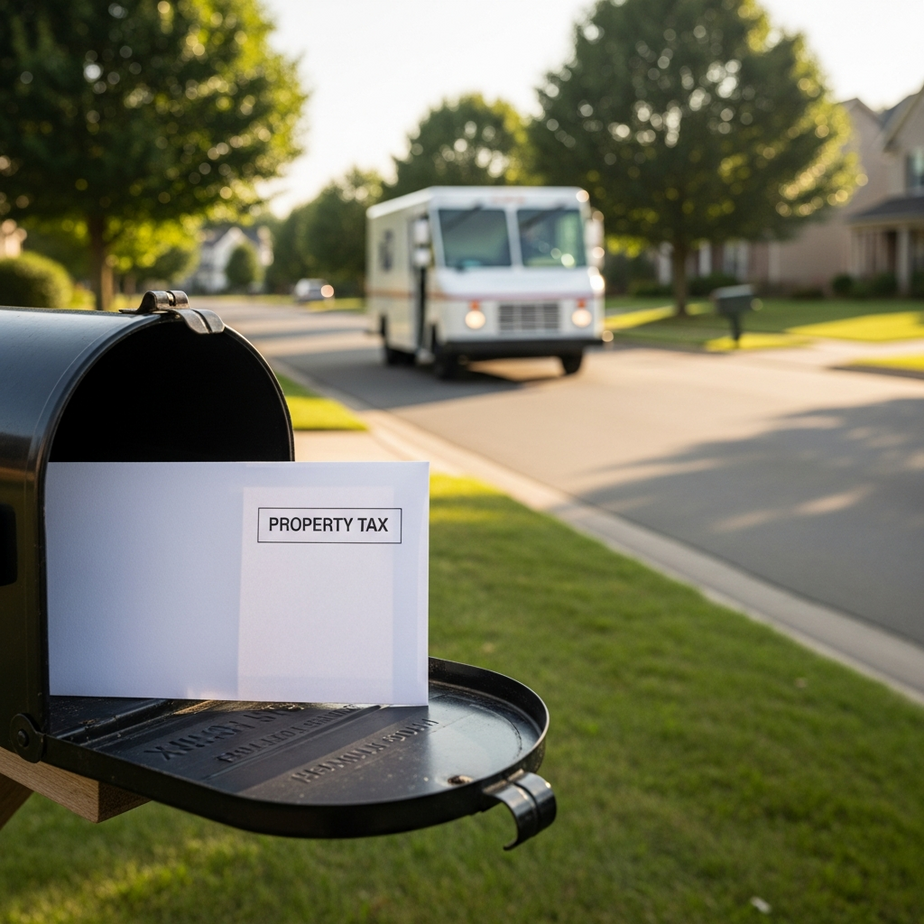
For homeowners across the country, the arrival of property tax bills is a familiar, if somewhat dreaded, annual or semi-annual event. You open the mailbox, retrieve the envelope, and mentally prepare your budget for one of the year’s most significant household expenses. For decades, the routine has been identical for millions of people: write a check, place it in an envelope, stamp it, and drop it in the nearest blue collection box before the deadline. As long as that envelope hit the bottom of the metal bin before the last pickup time on the due date, you were safe. However, relying on that old routine this year could be a costly mistake. Significant operational adjustments within the postal network have altered how mail is collected, sorted, and stamped. Specifically, USPS changes could affect mailed payments by delaying when a letter actually receives a postmark. For a birthday card, a day’s delay is an inconvenience. For a property tax bill with a statutory deadline, a one-day delay in postmarking can trigger substantial late fees and penalties, even if you technically mailed the item on time.
How USPS Network Changes Impact Your Mail
To understand why your tax payment might be at risk, it is helpful to understand what is happening behind the scenes at the United States Postal Service. In an effort to modernize operations and reduce costs, the postal service has been implementing a plan known as “Delivering for America.” Part of this plan involves consolidating processing centers and changing how local mail is handled. In the past, mail dropped in a local collection box was often taken to a nearby facility, sorted, and postmarked fairly quickly. Under the new “Local Transportation Optimization” initiative and other network consolidations, mail is frequently transported much farther away to regional processing distribution centers. This logistical shift means that letters dropped off in a collection box—even early in the day—might not reach the sorting facility until late that night or the following morning. Since the automated machines that apply the postmark are located at these processing centers, the date stamped on your envelope might be the day after you dropped it off. If you wait until the actual due date to mail your property tax bill, this processing lag means your payment will officially be considered late.
The Disconnect Between Pickup and Processing
Most people assume that the pickup time listed on a blue collection box guarantees that mail will be processed that day. If the box says “Last Pickup 5:00 PM,” and you drop your envelope at 4:30 PM, you naturally expect it to be postmarked with today’s date. With the recent operational changes, that assumption is no longer safe. The carrier will indeed collect the mail at 5:00 PM, but that mail may sit on a truck or in a holding facility before being transported to a distant regional hub for processing. If that truck doesn’t arrive at the hub before the cutoff time for that day’s operations, the mail is processed the next day. Consequently, the envelope bears the next day’s date. For tax collectors who are legally required to go by the postmark, your on-time effort looks exactly like a late payment.
The Legal Significance of the Postmark
When it comes to government payments, the postmark is king. Unlike utility bills or credit card payments, which usually must be received by the due date, property tax laws in many jurisdictions operate on the “mailbox rule.” This rule essentially states that payment is considered made on the date the United States Postal Service takes possession of it, as verified by the postmark. Tax collectors and treasurers are bound by strict statutes. They typically do not have the authority to waive late fees simply because a taxpayer claims they mailed the check on time. The physical proof on the envelope is the deciding factor. If a homeowner mails a $5,000 tax payment on the due date, and USPS changes cause the postmark to show the following day, the penalty is instantaneous. In many counties, the initial late fee is a percentage of the total bill—often starting at 1% to 10% immediately. On a large tax bill, that could mean throwing away hundreds of dollars simply because of a logistics delay you were unaware of.
Why Metered Mail Is Not a Solution
Some homeowners try to circumvent this issue by using office postage meters or online postage services (like Stamps.com or Pitney Bowes) where they can print the date on the envelope themselves. While this shows intent, it is often not sufficient proof for tax authorities. Most tax jurisdictions specify that if an envelope contains both a private meter date (which the user controls) and a USPS postmark, the USPS postmark takes precedence. If there is no USPS postmark, or if the postmark is illegible, the tax collector may look at the date the payment was actually received. If that receipt date is days after the deadline, the burden of proof shifts to the taxpayer, often resulting in a dispute that is difficult to win.
Strategies to Guarantee Your Payment is Marked On Time
Given that USPS changes could affect mailed payments this tax season, relying on a standard stamp and a blue drop box is a high-risk strategy, especially if you are paying close to the deadline. To ensure your payment is recorded accurately and you avoid unnecessary fines, you need to change your approach. Here are the most reliable methods to ensure your property tax payment clears the deadline without issue.
1. Hand-Canceling at the Post Office Counter
If you must mail a paper check on the actual due date, do not drop it in a slot. You should physically go into the post office lobby and wait in line for a clerk. When you reach the counter, ask the postal worker to “hand-cancel” the envelope. This means they will manually stamp the envelope with a round datestamp right in front of you. This stamp serves as undeniable official proof that the item was in the custody of the USPS on that specific date. It bypasses the risk of the letter riding on a truck to a regional facility before getting stamped.
2. Use Certified Mail with Return Receipt
For absolute peace of mind, send your payment via Certified Mail with a Return Receipt. This provides you with a mailing receipt that proves exactly when you handed the item over to the post office. It also gives you a signature confirmation when the tax office receives it. While this costs a few dollars more than a standard stamp, it is a cheap insurance policy compared to the potential penalties of a late property tax payment. If a dispute ever arises regarding the timeliness of your payment, the Certified Mail receipt is a legal document that stands up in court.
3. Utilize Local Drop Boxes
Most county treasurer and tax collector offices have secure drop boxes located directly at their facilities. These are often available 24 hours a day. If you are local to the area where you own property, skipping the mail entirely is often the smartest move. When you place a payment in the official tax office drop box before midnight on the due date, it is considered on time. Staff members typically open these boxes first thing the following morning and process everything inside as having been received the previous day. This completely removes the United States Postal Service from the equation.
4. Embrace Digital Payment Options
The most effective way to avoid the uncertainty of physical mail logistics is to stop using physical mail. Almost all taxing authorities now offer online payment portals. While some people avoid online payments due to “convenience fees,” it is important to read the fine print. Often, the fees apply only to credit card payments (which can be around 2.5%). However, “eCheck” or ACH payments—where you enter your bank routing and account number—are frequently free or cost a nominal flat fee (often less than $2.00). Paying online provides an instant digital confirmation number and a timestamp. You know immediately that your payment has been accepted, and you have a digital paper trail that is impossible to lose.
The Risks of “Float” and Check Washing
Beyond the postmark issues, there are other reasons to reconsider mailing high-value checks like property tax payments. The era of the “mail float”—writing a check knowing it won’t cash for a few days—is effectively over, yet the risks of physical mail theft are rising. Mail theft has become a significant problem in many communities. Criminals target blue collection boxes and personal mailboxes specifically looking for envelopes that appear to contain checks. Once stolen, these checks can be “washed” using chemicals to remove the ink, allowing thieves to rewrite the payee and the amount. Because property tax checks are often written for thousands of dollars, they are prime targets for fraudsters. If your tax payment is stolen and altered, you face a double nightmare: your bank account is drained, and your property taxes remain unpaid, accruing interest and penalties while you fight with the bank to restore your funds. Using electronic payment methods or delivering the check directly to the government office eliminates the risk of mail theft entirely.
Planning Ahead is the Ultimate Safeguard
The easiest way to mitigate the risk that USPS changes could affect mailed payments is simply to change your timeline. The deadline is the last possible moment to pay, not the recommended time to pay. If you prefer to mail a check, the best practice is to mail it at least seven to ten days before the due date. This buffer accounts for slower processing speeds, routing delays, and the potential for mail to be misdirected before reaching its destination. If you mail your payment a week early, the exact date of the postmark becomes irrelevant because it will still be well ahead of the deadline. However, human nature and financial constraints often mean people wait until the last minute. If you find yourself holding your tax bill on the due date, do not trust a blue box. The systems we relied on for years have evolved, and our habits must evolve with them.
Adapting to a New Logistics Landscape
The changes at the USPS are reflective of a broader shift in how society handles communication and commerce. As letter volume decreases, the postal service must adapt its infrastructure to remain viable, which inevitably leads to changes in service standards that the public may not immediately notice. For homeowners, this serves as a wake-up call. We can no longer take for granted that a letter dropped in a box today is “mailed” today in the eyes of the law. The machinery of logistics has slowed down for local mail, even as the digital world has sped up. When you hold that property tax bill, remember that it represents a significant financial obligation. It is worth the extra effort to ensure the payment is made securely and recognized as on time. Whether you choose to walk into the post office lobby, drive to the tax collector’s drop box, or log on to a payment portal, taking proactive control of the transaction is the only way to guarantee you won’t be hit with surprise penalties. Don’t let a logistical technicality cost you hard-earned money. Treat the mailbox with caution this tax season, and verify your postmark before you walk away.