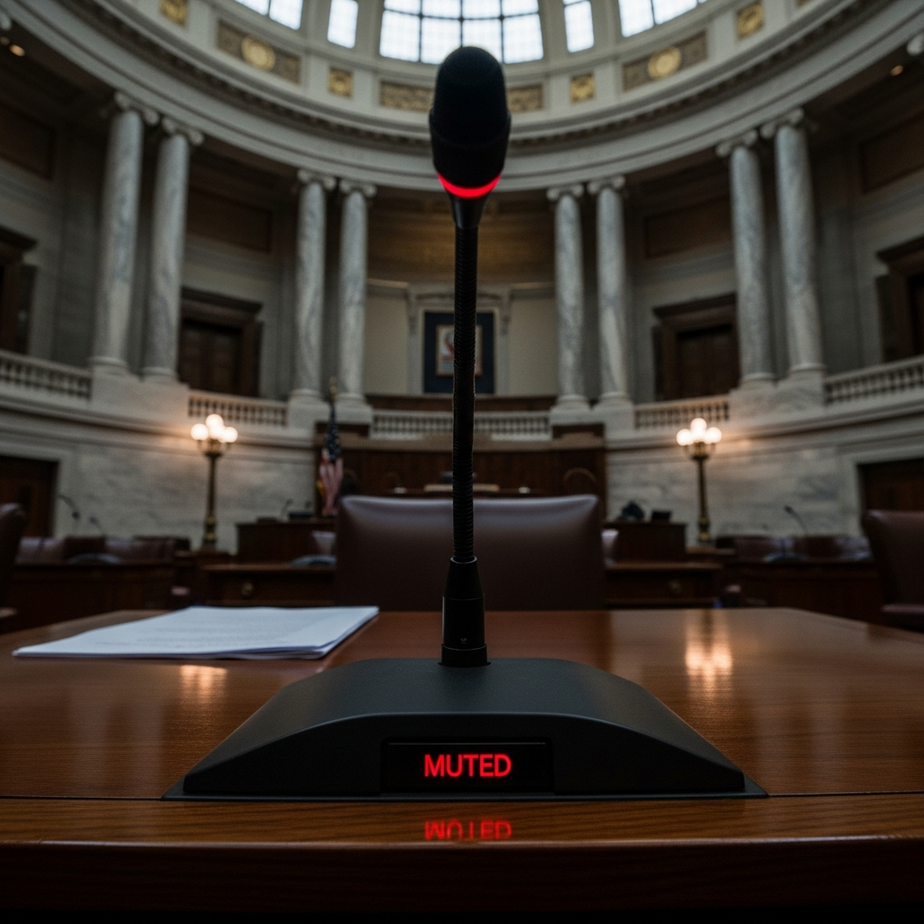
The Unseen Power of the Mute Button in Modern Politics
In the heat of a political debate, a raised voice or a point of order is a time-honored tradition. But what happens when the chamber is virtual and control rests not with a gavel, but with a mouse click? The allegation from an Ohio House Democrat that she was forcibly muted during a critical remote vote throws a stark light on the new technological realities governing our democratic institutions. This incident is more than just a procedural complaint; it’s a case study in how the tools designed to connect us also grant unprecedented power to control, and potentially silence, the conversation. As governments increasingly rely on remote technology, the question of who holds the digital gavel becomes one of paramount importance.
The claim that a lawmaker was forcibly muted raises immediate concerns about fairness, free speech, and the integrity of the legislative process itself. It forces us to examine the very platforms we use daily and ask whether they are truly fit for the nuanced and often contentious work of making laws.
Understanding the Technology of Remote Governance
When the world shifted online, so did government. City councils, school boards, and state legislatures adopted video conferencing platforms like Zoom, Microsoft Teams, and Webex to continue their essential work. While these tools offered a lifeline for continuity, they also introduced a new set of power dynamics dictated by the software’s architecture.
The Role of the Host and Co-Host
At the heart of any virtual meeting is the “host” or “moderator.” This individual wields significant administrative power over the session, powers that simply don’t have a direct equivalent in a physical chamber.
Key host controls include:
– Muting and unmuting participants
– Forcibly turning off a participant’s video
– Removing a participant from the meeting entirely
– Controlling who can share their screen
– Managing breakout rooms and waiting rooms
In a legislative context, the person assigned the host role—often a committee chair, a clerk, or a designated IT staffer—effectively becomes the digital sergeant-at-arms. Their ability to mute a participant is absolute. When a lawmaker claims they were forcibly muted, they are describing an action where the host used their administrative privileges to silence their microphone without their consent.
How Muting Functionality Works
On most platforms, muting is a straightforward feature. A host can “Mute All” to silence background noise or selectively mute individuals who may be speaking out of turn or causing a disruption. The critical distinction lies in the settings. Some platforms allow hosts to prevent participants from unmuting themselves, creating a scenario where a person is truly silenced until the host permits them to speak again.
This is a far cry from a traditional setting, where a presiding officer might bang a gavel and rule a member out of order, but cannot physically prevent them from speaking. The technology creates a definitive and instantaneous block on communication. The concern arises when this tool is used not for procedural order, but to curtail debate or dissent, leaving the affected member with little recourse in the moment. Being forcibly muted can be a jarring and effective way to control the flow of debate.
A Feature or a Flaw? The Debate Over Digital Control
The ability to mute participants is, by design, a feature intended to create orderly meetings. Anyone who has been in a large virtual call with multiple people talking at once understands its necessity. Background noise, accidental unmuting, and intentional disruptions can derail a meeting quickly. In this sense, the mute button is an essential tool for moderation.
However, in the context of democratic deliberation, this feature’s potential for misuse becomes a significant flaw. The very nature of legislative debate involves passionate, sometimes loud, and often overlapping arguments. Parliamentary procedure was developed over centuries to manage this inherent chaos in a structured way. Introducing a technological tool that allows one person to unilaterally silence another bypasses these established norms.
Legitimate Use vs. Potential Abuse
Consider the following scenarios:
1. **Legitimate Use:** A committee hearing is underway, and a member’s microphone is picking up loud construction noise, making it impossible to hear the person testifying. The chair mutes the member’s microphone to allow the hearing to proceed and sends them a private message to resolve the issue. This is a reasonable use of the tool for the benefit of the group.
2. **Potential Abuse:** During a vote on a contentious bill, a member from the minority party attempts to raise a point of order or voice a final objection. The committee chair, wanting to expedite the vote, simply mutes the dissenting member. In this case, the member was forcibly muted not for causing a disruption, but for attempting to participate in the established political process.
The Ohio lawmaker’s claim falls squarely into the second category. She asserted she was attempting to raise a concern with Congresswoman Joyce Beatty, who was presiding, when her ability to speak was suddenly revoked. It highlights the core tension: the line between maintaining order and suppressing dissent can be incredibly thin in a digital forum, and the power to draw that line rests with the meeting host. This situation underscores the fear that being forcibly muted could become a new political tactic.
Forging New Rules for a Digital Parliament
The incident serves as a critical warning that traditional parliamentary rules are not sufficient for governing digital spaces. Legislative bodies must proactively create new protocols and standards of conduct for remote and hybrid sessions to ensure fairness and transparency. Relying on the default settings of a commercial software platform is not a sustainable or democratic solution.
Establishing Clear Digital Decorum
First and foremost, legislatures need to establish a clear and publicly accessible “digital rules of order.” This document should explicitly outline the powers and limitations of the meeting host.
Key questions these rules must answer include:
– Under what specific circumstances can a member be muted?
– Is the host required to provide a verbal warning before muting a member?
– Can a host prevent members from unmuting themselves? If so, for how long and for what reasons?
– What is the digital equivalent of a “point of order”? Is there a mechanism, like a “raise hand” feature or a dedicated chat channel, that a member can use to be recognized, even if muted?
Without these explicit rules, decisions are left to the discretion of the individual host, opening the door for accusations of bias and political maneuvering. The goal is to make the process predictable and fair, so that a member who feels they were wrongly and forcibly muted can point to a specific rule violation.
The Importance of an Auditable Record
In a physical chamber, the proceedings are recorded by stenographers and video cameras, creating an official public record. Digital proceedings require an even more robust and transparent record. The platform’s own logs can provide an invaluable, objective account of the meeting’s events.
Modern video conferencing platforms can generate detailed reports that show:
– Who joined and left the meeting, and at what time.
– Who muted or unmuted whom, with a precise timestamp.
– Chat logs, both public and, in some cases, private.
– Polling results and Q&A submissions.
Making these digital logs part of the official public record is a crucial step toward accountability. If a lawmaker claims they were forcibly muted, these logs can either substantiate or refute their claim instantly. As the Electronic Frontier Foundation (EFF) often argues, transparency is a cornerstone of holding power accountable, and this applies just as much to digital governance as it does to any other government action. Demanding access to these logs ensures that the digital gavel is wielded in the public eye.
Safeguards to Protect Digital Democracy
Beyond creating new rules, there are technical and procedural safeguards that can be implemented to protect the integrity of remote legislative sessions. These solutions aim to distribute power more evenly and reduce the potential for any single individual to control the debate unfairly.
Technical and Procedural Solutions
Co-Hosting and Bipartisan Moderation
A simple yet effective solution is to never have a single host. By assigning host privileges to at least two people, preferably from different political parties, you create an immediate check on power. A “co-host” model would require consensus or at least prevent a single actor from unilaterally silencing opposition. Muting a member might require confirmation from the co-host, adding a crucial layer of deliberation to the action.
Dedicated Channel for Procedural Motions
To solve the problem of a muted member being unable to get the chair’s attention, a dedicated and unblockable channel for procedural motions could be established. This could be a specific chat function or a separate communication tool monitored by non-partisan staff, like the chamber’s clerk. A member could use this channel to officially signal a “Point of Order” or “Request for Recognition,” creating a formal record that cannot be ignored or deleted by the host.
Third-Party, Non-Partisan Tech Staff
Instead of giving hosting powers to the committee chair—an inherently political actor—legislatures could delegate this role to trained, non-partisan IT staff. These individuals would operate under the strict, publicly-defined digital rules of order. Their job would not be to manage the content of the debate, but to ensure the technology functions smoothly and fairly for all participants. If a member is forcibly muted, it would be by a neutral arbiter acting on a clear rule violation, not by a political opponent.
The future of governance is undeniably hybrid. The convenience, accessibility, and cost-effectiveness of remote participation mean that virtual meetings are here to stay. This incident is not an argument against remote governance, but a powerful call to implement it thoughtfully and deliberately. We must build a digital infrastructure that upholds, rather than undermines, the principles of open debate and democratic representation.
The story of the Ohio House Democrat who says she was forcibly muted is a lesson for every level of government. It reminds us that technology is never neutral; it reflects the values and rules we embed within it. By establishing transparent protocols, demanding auditable records, and designing systems with built-in checks and balances, we can ensure that the virtual public square remains a place for all voices to be heard. To learn more about how technology is shaping modern governance, explore the digital transparency initiatives being adopted by legislatures across the country.