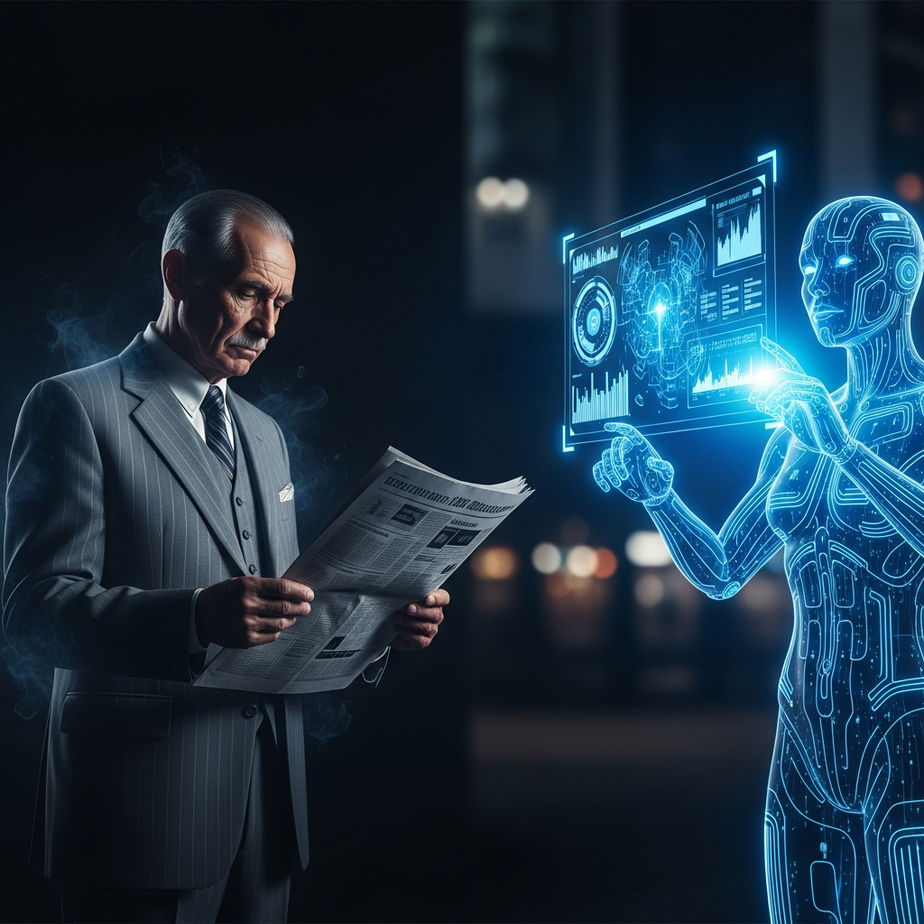
The rapid evolution of technology has always reshaped the workforce, but the current wave of innovation feels different, particularly for the seasoned veterans of the corporate world. For decades, the most valuable asset in any office was the person who had seen it all—the employee with decades of institutional memory, deep industry relationships, and gut instincts honed by years of trial and error. However, a new narrative is emerging that suggests Artificial Intelligence is making old guys obsolete by digitizing the very wisdom that once offered them job security. The anxiety surrounding this shift is palpable. It is no longer just about automation replacing manual labor; it is about algorithms replacing experience. When a chatbot can instantly recall a company’s entire history, draft a legal brief in seconds, or predict market trends faster than a human analyst, the premium placed on “having been there” begins to diminish. This technological disruption forces us to ask uncomfortable questions about the value of seniority in a world where speed and data processing power often trump wisdom.
The Erosion of Institutional Memory
For generations, the “old guy” in the office—a term used here to describe the archetypal senior professional regardless of specific demographics—served as a living library. They knew why certain policies existed, they remembered the failure of a similar project twenty years ago, and they knew exactly who to call to get a deal unstuck. This role provided a protective moat around their careers. They were indispensable because their knowledge was not written down; it was stored in their minds. Generative AI changes this dynamic fundamentally. Companies are increasingly feeding their internal data, emails, reports, and project histories into large language models. Suddenly, the answers that used to require a conversation with a senior partner are available to a junior associate via a simple text prompt. The democratization of information means that the gatekeepers of knowledge are losing their keys. This shift is particularly jarring because it happens so quickly. A lifetime of accumulated knowledge can be scraped, indexed, and retrieved by software in milliseconds. If the primary value of a senior employee is simply “knowing things,” then Artificial Intelligence is making old guys obsolete at a frightening pace. To survive, the definition of value must shift from information retention to information synthesis.
Speed Versus Nuance in the Modern Workplace
One of the defining characteristics of the AI revolution is speed. Artificial intelligence operates at a velocity that human cognition cannot match. In many modern industries, the ability to produce “good enough” work instantly is valued more highly than the ability to produce “perfect” work slowly. This preference for velocity places older workers at a distinct disadvantage. Senior professionals often pride themselves on a methodical approach. They like to deliberate, consider the angles, and rely on a slow-cooked intuition. In a pre-digital era, this was seen as prudence. In the age of AI, it is often viewed as a bottleneck. When a twenty-something employee can use AI tools to generate ten marketing strategies in the time it takes a senior manager to pour a cup of coffee, the perceived efficiency gap widens. However, this reliance on speed creates a dangerous blind spot. AI models are notoriously confident but often wrong—a phenomenon known as hallucination. They lack the nuanced understanding of human psychology, ethics, and long-term consequences. This is where the narrative that Artificial Intelligence is making old guys obsolete begins to fracture. While AI wins on speed, it loses on judgment. The challenge for older workers is to prove that their judgment is worth the wait.
The Trap of the “Digital Immigrant”
The friction between AI and older workers is also exacerbated by the learning curve. Younger generations, often termed “digital natives,” have grown up adapting to new interfaces and software paradigms instinctively. For them, treating an AI as a collaborative partner feels natural. Conversely, for those who spent the bulk of their careers perfecting traditional workflows, integrating AI can feel counterintuitive. There is a hesitation to trust the machine, or simply a lack of familiarity with how to prompt it effectively. This hesitation can be fatal professionally. Resistance to adopting these tools reinforces the stereotype that older workers are rigid and unwilling to adapt, further accelerating their obsolescence in the eyes of management.
The Soft Skills That Algorithms Cannot Replicate
Despite the doom and gloom, there is a strong counter-argument to the idea that senior professionals are finished. While AI excels at data processing, it fails miserably at emotional intelligence. Business, at its core, is still about human relationships. An algorithm cannot take a client out to dinner to soothe their concerns. It cannot mentor a struggling junior employee through a personal crisis. It cannot navigate the complex internal politics of a boardroom negotiation. These “soft skills” are the domain of the experienced professional. The “old guys” have spent decades learning how to read a room, how to persuade skeptics, and how to build trust. These are deeply human capabilities that require empathy and shared experience. As AI takes over the technical and administrative drudgery, the value of these interpersonal skills will likely skyrocket. Harvard Business Review and other authoritative sources have frequently noted that as technical skills become commoditized by automation, social skills become the true differentiator. Therefore, the senior workers who will survive are those who pivot. They must stop trying to compete with the computer on IQ and start leveraging their EQ (Emotional Intelligence).
Moving From Creator to Editor
Another area where experience remains vital is in the role of the editor. AI can generate vast amounts of content, code, and analysis, but it requires a human to verify accuracy and relevance. This role requires a deep understanding of the subject matter—the kind of understanding that only comes with time. A junior employee might accept an AI-generated strategy at face value because it looks professional. A senior veteran, however, can look at the same output and immediately spot the strategic flaws or the lack of industry context. In this sense, Artificial Intelligence is making old guys obsolete only if they insist on doing the grunt work themselves. If they transition into the role of “Chief Editor” or “Strategic Overseer,” their experience becomes the guardrail that keeps the company from running off a cliff.
Strategies for Survival and Reinvention
For senior professionals reading the writing on the wall, passivity is not an option. The workforce is evolving, and relying on tenure is no longer a viable safety net. To combat the narrative of obsolescence, older workers must proactively reshape their value proposition. The first step is radical upskilling. This does not mean learning how to code Python, but it does mean achieving fluency in AI tools. A senior leader who knows how to leverage AI to amplify their own productivity is a formidable force. This is often referred to as the “Centaur” model—half human, half machine. A veteran with thirty years of experience who also uses ChatGPT to speed up their workflow can run circles around a junior employee who has the tool but lacks the wisdom to use it effectively.
Mentorship as a Currency
Senior professionals should also double down on mentorship. In a world where junior employees are increasingly relying on screens for answers, the art of human apprenticeship is dying. By positioning themselves as mentors who can teach the nuances that AI cannot, older workers make themselves indispensable to the development of the next generation. Companies eventually realize that while AI can provide answers, it cannot build culture. Culture is transmitted through stories, shared experiences, and the guidance of those who have weathered previous storms. The “old guy” becomes the custodian of culture, a role that software is incapable of filling.
The Societal Risk of discarding Wisdom
There is a broader societal implication to the idea that Artificial Intelligence is making old guys obsolete. If the business world systematically purges older workers in favor of cheaper, AI-augmented youth, we risk a “wisdom drain.” History is replete with patterns that repeat themselves. Financial bubbles, geopolitical conflicts, and corporate scandals often follow predictable cycles. Those who have lived through previous cycles offer a perspective that data alone cannot provide. Data looks backward, but human experience projects emotional context forward. If we remove the “gray hair” from the room, we remove the voice of caution. We remove the person who says, “We tried this in the 90s, and here is why it failed.” Without that check and balance, companies risk making high-speed errors at scale. The efficiency gained by AI could be completely negated by the strategic blunders caused by a lack of experienced oversight.
Redefining “Obsolete” in the AI Era
The fear that AI will displace older men and women in the workforce is grounded in reality, but it is not a foregone conclusion. Displacement only happens when there is a refusal to adapt. The calculator did not make mathematicians obsolete; it allowed them to focus on more complex problems. similarly, AI should not replace the senior professional; it should liberate them from the mundane. The narrative that Artificial Intelligence is making old guys obsolete is a warning, not a verdict. It serves as a wake-up call for senior professionals to let go of the tasks that machines can do better and embrace the tasks that only humans can do. The future of work will likely belong to those who can bridge the gap—combining the raw processing power of artificial intelligence with the nuanced, empathetic, and strategic wisdom of experience. The “old guy” isn’t finished yet, but his job description has certainly changed.
Embracing the Evolution of Work
The technological tide is rising, and it does not discriminate by age. However, those with a career’s worth of experience have a unique foundation upon which to build. The transition requires humility, curiosity, and a willingness to become a student again. By viewing AI as a tool rather than a replacement, senior professionals can extend their careers and increase their impact. The combination of deep experience and cutting-edge technology is powerful. Don’t let the narrative define your future. Explore new tools, mentor the younger generation, and lean into the human skills that no algorithm can touch. The workplace still needs wisdom, perhaps now more than ever.