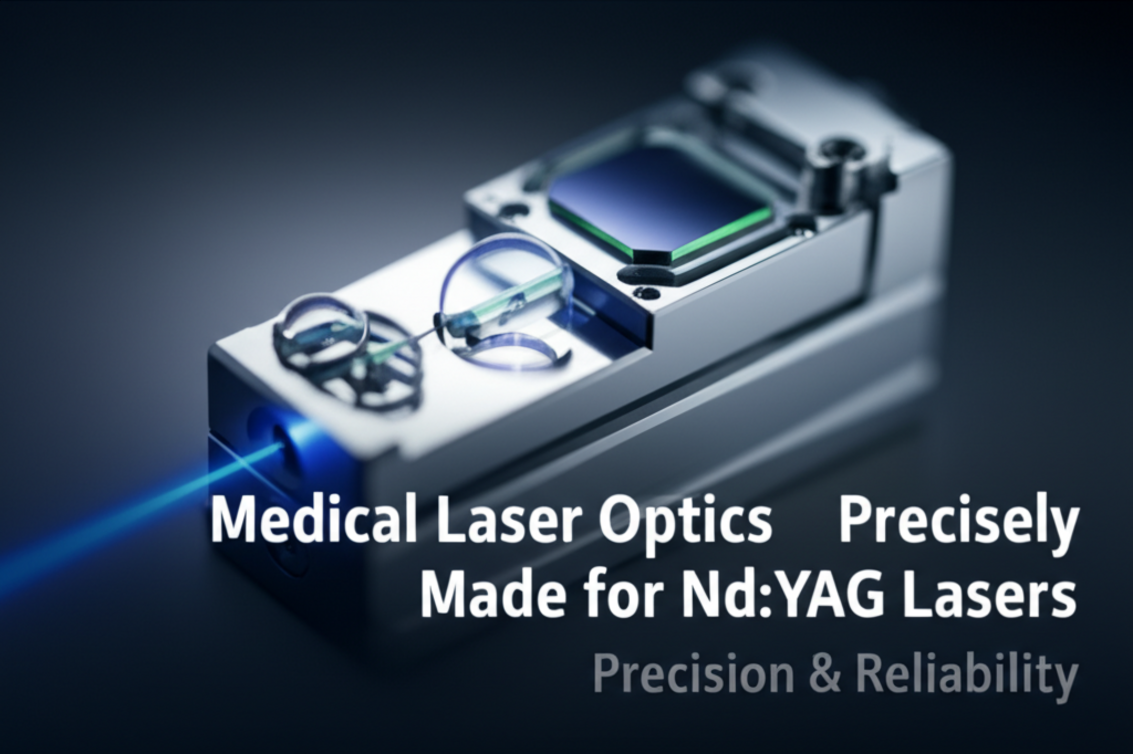
Medical laser technology has surged in recent years, offering surgeons, dermatologists, and researchers more precise, efficient tools for a wide range of treatments. Among the most widely used laser platforms is the Nd:YAG system, renowned for its deep tissue penetration and versatility. However, to fully harness the power of Nd:YAG lasers, the optical components—lenses, output couplers, and mirrors—must be engineered to match the laser’s unique characteristics. That’s where Laser Research Optics steps in with its line of zinc selenide (ZnSe) optics, tailored specifically for 1064 nm output.
Why Nd:YAG Laser Systems Demand Specialized Optics
Nd:YAG lasers emit light at a wavelength of 1064 nm, a region where many conventional optical materials (such as glass or fused silica) exhibit increased absorption and thermal loading. When these materials are exposed to high‑energy laser pulses, they can heat up, distort, or even degrade—compromising beam quality and patient safety. Engineers therefore turn to high‑bandgap, infrared‑transparent materials that can endure intense power densities while maintaining minimal loss.
ZnSe is a leading candidate because of its:
- Broad transmission window from 0.6 µm to 20 µm, ensuring negligible absorption at 1064 nm.
- Low refractive index (~2.55) that allows compact lens designs.
- Excellent thermal conductivity and high damage threshold.
These properties make ZnSe optics a natural fit for medical applications that demand both precision and reliability.
Introducing Laser Research Optics’ ZnSe Solutions
On September 23, 2025, Laser Research Optics announced a new suite of custom‑manufactured ZnSe optical components designed for Nd:YAG laser systems. The line includes:
- ZnSe Lenses: Curved and flat elements optimized for 1064 nm, engineered to deliver diffraction‑limited focus with minimal spherical aberration.
- Output Couplers: High‑efficiency, low‑loss plates that extract a precise fraction of the intracavity power while preserving beam quality.
- Mirrors: Dielectric‑coated ZnSe mirrors with reflectivities exceeding 99.5 % at 1064 nm, designed for use in high‑power resonators.
All components are fabricated to industry‑standard tolerances, ensuring seamless integration into existing Nd:YAG systems.
Engineering the 1064 nm Advantage
Optimizing optics for a single wavelength brings a host of benefits:
- Reduced Chromatic Aberration: By tailoring the refractive index profile specifically for 1064 nm, the lenses maintain focus across a wide range of beam energies.
- Enhanced Thermal Stability: ZnSe’s low absorption minimizes heat buildup, preserving optical alignment even during prolonged use.
- Improved Beam Quality: High‑precision surface figuring and anti‑reflection coatings keep wavefront distortion below 0.01 λ, essential for surgical precision.
These design choices translate directly into improved patient outcomes, whether the laser is used for vascular ablation, skin resurfacing, or deep‑tissue ablation.
Performance Highlights: Lenses, Output Couplers, and Mirrors
Lenses – The ZnSe lenses feature a custom aspheric surface that corrects for spherical aberration while maintaining a simple, manufacturable shape. Typical focal lengths range from 30 mm to 300 mm, covering most clinical use cases from superficial skin treatments to deep‑tissue procedures.
Output Couplers – These components are fabricated with a graded‑index coating that ensures a fixed output coupling ratio (e.g., 5 % or 10 %) across a wide power range. The result is a stable laser output, crucial for procedures that require repeatable energy delivery.
Mirrors – The high‑reflectivity ZnSe mirrors are designed to withstand peak intensities exceeding 10 MW/cm². Their dielectric stack is engineered to provide angular tolerance, allowing flexible mounting in varied optical layouts.
Clinical Impact and Applications
The integration of these specialized ZnSe optics brings tangible benefits to medical practice:
- Consistent Energy Delivery: Surgeons can rely on a predictable beam profile, reducing the margin for error during critical procedures.
- Lower Maintenance Costs: The durability of ZnSe components translates into fewer replacements and less downtime.
- Expanded Treatment Options: The ability to focus tightly on deeper tissues opens new therapeutic avenues, such as targeted tumor ablation and advanced refractive surgery.
For dermatologists, the result is smoother skin resurfacing with reduced scarring. For orthopedic specialists, the enhanced beam stability facilitates precise laser‑assisted joint repair.
Choosing the Right Optics for Your Practice
When selecting optics for an Nd:YAG system, consider the following factors:
- Power Range: Match component damage thresholds to your laser’s maximum output.
- Beam Divergence: Choose lenses with focal lengths that meet your tissue interaction depth.
- Mounting Compatibility: Verify that the optical mounts fit your existing system architecture.
- Warranty & Support: Opt for suppliers offering comprehensive post‑sale support, ensuring long‑term reliability.
Laser Research Optics offers a personalized consultation service to help clinicians determine the optimal optical configuration for their specific laser platform and procedural goals.
Future Trends in Medical Laser Optics
As laser technology evolves, so too does the demand for ever more precise optics. Emerging trends include:
Adaptive Optics: Real‑time wavefront correction could further improve focus, particularly in heterogeneous biological tissues.
Hybrid Material Coatings: Combining ZnSe with novel anti‑reflection layers could push reflectivity above 99.9 % while reducing cost.
Integration with Imaging: Coupling laser optics with real‑time imaging systems can enhance targeting accuracy, especially in neurosurgery.
By staying ahead of these developments, clinicians can continue to offer state‑of‑the‑art care that leverages the full potential of Nd:YAG lasers.
In summary, Laser Research Optics’ custom ZnSe components represent a significant leap forward in medical laser technology. Their tailored design for 1064 nm, combined with superior thermal and optical performance, empowers healthcare professionals to deliver safer, more effective treatments. Whether you’re looking to upgrade an existing Nd:YAG system or design a new one from the ground up, these high‑quality optics provide a robust foundation for medical excellence.