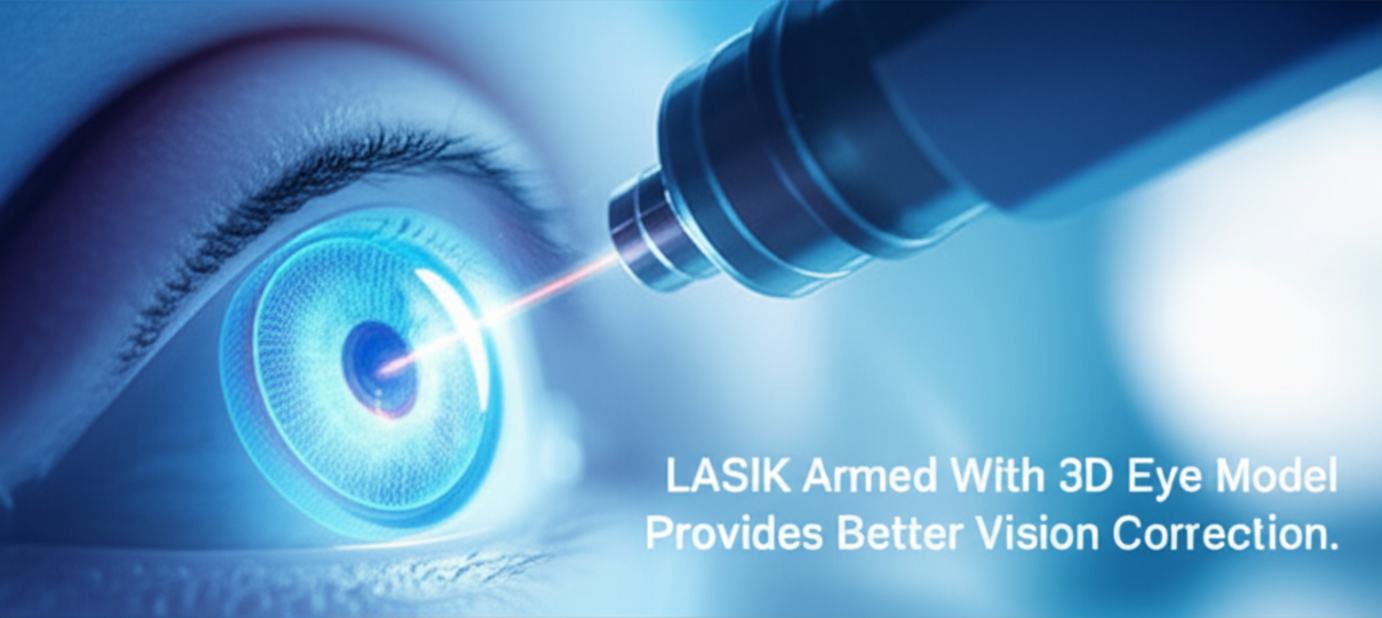
Revolutionizing Vision: The Power of 3D Eye Models in LASIK
For decades, LASIK has been hailed as a breakthrough in refractive eye surgery, promising freedom from glasses and contact lenses. Yet, even the most advanced laser systems relied on two-dimensional imaging and standard measurements that could miss subtle irregularities in a patient’s cornea. Enter 3D eye modeling—a technological leap that brings unprecedented precision to vision correction. In this article, we explore how 3D eye models are reshaping LASIK outcomes, what patients can expect, and why this innovation matters for the future of ophthalmic care.
Why 3D Matters: Beyond the Flat Surface
Traditional LASIK planning depends largely on corneal topography—essentially a 2D map of the front surface of the eye. While effective for many, this method can overlook variations in corneal thickness, subtle irregularities, and the dynamic behavior of the eye under different lighting conditions. A 3D eye model, on the other hand, reconstructs the entire corneal geometry, including the back surface and stromal layers, using high-resolution imaging techniques such as Scheimpflug photography and optical coherence tomography (OCT). This volumetric data allows surgeons to:
- Accurately assess corneal thickness at every point, ensuring tissue safety.
- Detect micro‑aberrations that could compromise post‑surgery visual quality.
- Simulate laser ablation with millimeter‑level precision, predicting how the cornea will reshape.
- Tailor treatment plans to the individual’s unique eye anatomy rather than relying on generic formulas.
The Science Behind the Model
The creation of a 3D eye model involves capturing thousands of cross‑sectional images across the entire cornea and stitching them into a digital volume. Advanced algorithms then segment the corneal layers, measure curvature and thickness variations, and generate a comprehensive 3D map. Surgeons can view the model from multiple angles, zoom in on areas of concern, and even overlay the proposed laser ablation pattern to anticipate outcomes.
One of the key advantages is the ability to perform “custom ablation” or wavefront‑guided LASIK. By analyzing the patient’s wavefront aberrations—imperfections that cause blurry vision—surgeons can sculpt the cornea to correct both standard refractive errors (myopia, hyperopia, astigmatism) and higher‑order aberrations. This results in sharper night vision, reduced halos, and an overall more natural visual experience.
Clinical Benefits: What Patients Experience
Studies comparing conventional LASIK to 3D model‑guided LASIK consistently show higher visual acuity, greater stability, and fewer complications. Key outcomes include:
- Higher UDVA (Uncorrected Distance Visual Acuity): Patients report seeing 20/15 or better in a majority of cases.
- Reduced Regression: The cornea maintains its shape longer, decreasing the likelihood of vision changes over time.
- Fewer Dry Eye Symptoms: Precise ablation preserves more corneal nerves, mitigating postoperative dryness.
- Enhanced Contrast Sensitivity: Patients notice clearer vision in low‑light settings, which is often a challenge with standard LASIK.
These benefits translate into higher patient satisfaction scores and lower rates of retreatment or enhancement surgeries.
Step‑by‑Step: From Imaging to Surgery
1. Comprehensive Eye Evaluation: The process begins with a detailed examination, including visual acuity tests, slit‑lamp inspection, and pupil dilation.
2. 3D Imaging Capture: Using a Scheimpflug camera or OCT system, the surgeon acquires volumetric data of the cornea and anterior segment.
3. Data Processing & Model Creation: Software algorithms reconstruct the 3D model, identify aberrations, and suggest an ablation strategy.
4. Patient Consultation: Surgeons review the model and proposed plan with the patient, addressing any concerns and adjusting parameters if needed.
5. Laser Ablation: On the day of surgery, the excimer laser follows the customized pattern to reshape the cornea.
6. Post‑operative Care & Follow‑up: Patients receive eye drops and scheduled follow‑up visits to monitor healing and visual outcomes.
Challenges and Considerations
While 3D eye modeling offers remarkable advantages, it is not without challenges. The technology requires specialized equipment and training, which can increase upfront costs. Additionally, the accuracy of the model depends on the quality of the imaging; movement or poor lighting can introduce artifacts. Finally, patients with certain conditions—such as keratoconus—may still need alternative treatments because the cornea’s irregular shape limits laser safety margins.
Future Directions: AI, Telemedicine, and Personalized Vision Care
Artificial intelligence is poised to further refine 3D modeling by automating defect detection, predicting healing responses, and optimizing ablation patterns in real time. Coupled with tele‑ophthalmology, patients in remote areas could receive detailed pre‑operative assessments via secure video links, followed by on‑site surgeries performed by specialists trained in 3D‑guided LASIK.
Moreover, the integration of corneal biomechanics into 3D models will allow surgeons to consider the eye’s mechanical properties, leading to even safer procedures for high‑risk patients.
Conclusion: A New Era of Precision Vision
The adoption of 3D eye models in LASIK represents a paradigm shift in refractive surgery. By moving beyond flat maps to volumetric, patient‑specific analysis, surgeons can deliver more accurate, stable, and satisfying visual outcomes. For individuals looking to ditch glasses or contacts, this technology offers a promising path to clearer, sharper vision—backed by cutting‑edge science and personalized care. As 3D modeling becomes more accessible and integrated into standard practice, the future of vision correction looks brighter than ever.
Ready to explore whether 3D model‑guided LASIK is right for you? Schedule a consultation with a board‑certified ophthalmologist today and take the first step toward lasting visual freedom.