Why Your Standard Fire Extinguisher Is a Recipe for Disaster
That familiar red canister mounted on the wall gives you a sense of security. But if a fire starts in your server rack, entertainment center, or home office setup, grabbing that standard ABC extinguisher could be a catastrophic mistake. While it might put out the flames, it will almost certainly destroy the very equipment you were trying to save. Understanding why requires looking at what’s actually inside those canisters.
Most general-purpose fire extinguishers are the ABC dry chemical type. They are incredibly effective at smothering fires involving wood, liquids, or electrical sources. However, they work by spraying a fine powder, typically monoammonium phosphate. This powder is a nightmare for electronics. It’s highly corrosive, gets into every tiny crevice, and is nearly impossible to clean completely. Imagine a fine, acidic dust coating your motherboard, power supply, and hard drive connectors. Even if the fire was small, the “cure” will permanently kill your gear.
The Problem with Water and Foam
It might seem obvious, but it bears repeating: never use a water-based (Class A) fire extinguisher on an electrical fire. Water is an excellent conductor of electricity. Spraying it onto a live electronic device not only guarantees the device is fried but also creates a severe risk of electrocution for you.
Foam extinguishers (Class A:B) are similarly hazardous. The foam contains a high percentage of water, presenting the same shock hazard. Both water and foam will cause immediate and irreversible short-circuiting and long-term corrosion on any circuit board they touch.
The Corrosive Nightmare of Dry Chemical Extinguishers
The Class ABC extinguisher is the most common type found in homes and offices. While it carries a “C” rating for electrical fires, this only means the extinguishing agent is non-conductive. It does not mean it’s safe for the electronics themselves.
The powder discharged is incredibly fine and propelled under high pressure, ensuring it penetrates deep inside device casings, vents, and ports. This residue is corrosive and attracts moisture from the air, creating an acidic sludge that eats away at delicate solder joints and circuits over time. Attempting to clean it is a specialist’s job, and often, the labor cost exceeds the value of the equipment. For a business, using an ABC extinguisher in a server room could mean a total loss of hardware, even for equipment that wasn’t directly touched by flames.
A Crash Course in Fire Extinguisher Classes
To choose the right tool for the job, you first need to understand the different types of fires. Fire safety professionals classify fires into five distinct categories based on the fuel source. The letter on the side of an extinguisher tells you which class of fire it is designed to fight. Using the wrong class of extinguisher can be ineffective at best and dangerously counterproductive at worst.
Class A: Ordinary Combustibles
This is the most common type of fire. Class A fires involve solid combustible materials like wood, paper, cloth, rubber, and most plastics. A water or foam extinguisher is ideal for these fires as it cools the material below its ignition temperature.
Class B: Flammable Liquids and Gases
Class B fires involve flammable or combustible liquids such as gasoline, oil, propane, and natural gas. Smothering the fire by cutting off its oxygen supply is the primary method here. Foam, carbon dioxide, and dry chemical extinguishers are effective. Water should not be used as it can spread the flaming liquid.
Class C: Energized Electrical Equipment
This is the critical category for our topic. A Class C fire involves energized electrical equipment, like computers, servers, motors, and transformers. The key is that electricity is the source of the fire. The extinguishing agent must be non-conductive to prevent electrical shock. Once the power to the equipment is cut, the fire often becomes a Class A fire. This is why many extinguishers are rated for multiple classes, like A:B:C. The “C” simply indicates the agent is safe to use on a live circuit.
Class D: Combustible Metals
This is a rare and specialized class of fire found mostly in industrial settings. Class D fires involve combustible metals like magnesium, titanium, and sodium. They require a special dry powder extinguishing agent, as water or other agents can cause a violent, explosive reaction.
Class K: Cooking Oils and Fats
Primarily for commercial kitchens, Class K fires involve cooking oils, grease, and animal fats. They burn at extremely high temperatures, and a special wet chemical agent is needed to cool and saponify the fat (turn it into a soapy foam) to prevent re-ignition.
The Best Types of Fire Extinguishers for Electronics
Now that you understand that a simple “C” rating isn’t enough to guarantee the safety of your hardware, let’s explore the best options. The ideal fire extinguishers for electronics put out the fire without causing further damage or leaving behind a destructive mess. These are often referred to as “clean agent” extinguishers.
Carbon Dioxide (CO2) Extinguishers
A carbon dioxide extinguisher is a significant step up from a dry chemical unit for protecting electronics. These extinguishers are typically rated for Class B and C fires. They work by displacing oxygen to smother the fire and discharging a very cold gas that helps cool the fuel source.
Advantages of CO2 Extinguishers
– No Residue: CO2 is a gas that dissipates into the atmosphere after use, leaving absolutely no residue behind. There is no powder or liquid to clean up, and no corrosive material left to damage your equipment.
– Non-Conductive: It is completely safe for use on energized electrical equipment.
– Fast and Effective: It quickly smothers fires in enclosed or semi-enclosed spaces.
Disadvantages of CO2 Extinguishers
– Oxygen Displacement: In a small, unventilated space like a server closet or small office, discharging a CO2 extinguisher can displace enough oxygen to create a suffocation hazard for people. Proper ventilation is crucial.
– Thermal Shock: The CO2 exits the nozzle at an extremely cold temperature (around -109°F or -78°C). This rapid temperature drop can cause thermal shock to sensitive microchips and circuit boards, potentially cracking them.
– Limited Effectiveness Outdoors: As a gas, its effectiveness is reduced in open or windy areas where it can be quickly dispersed.
Clean Agent Halogenated Extinguishers
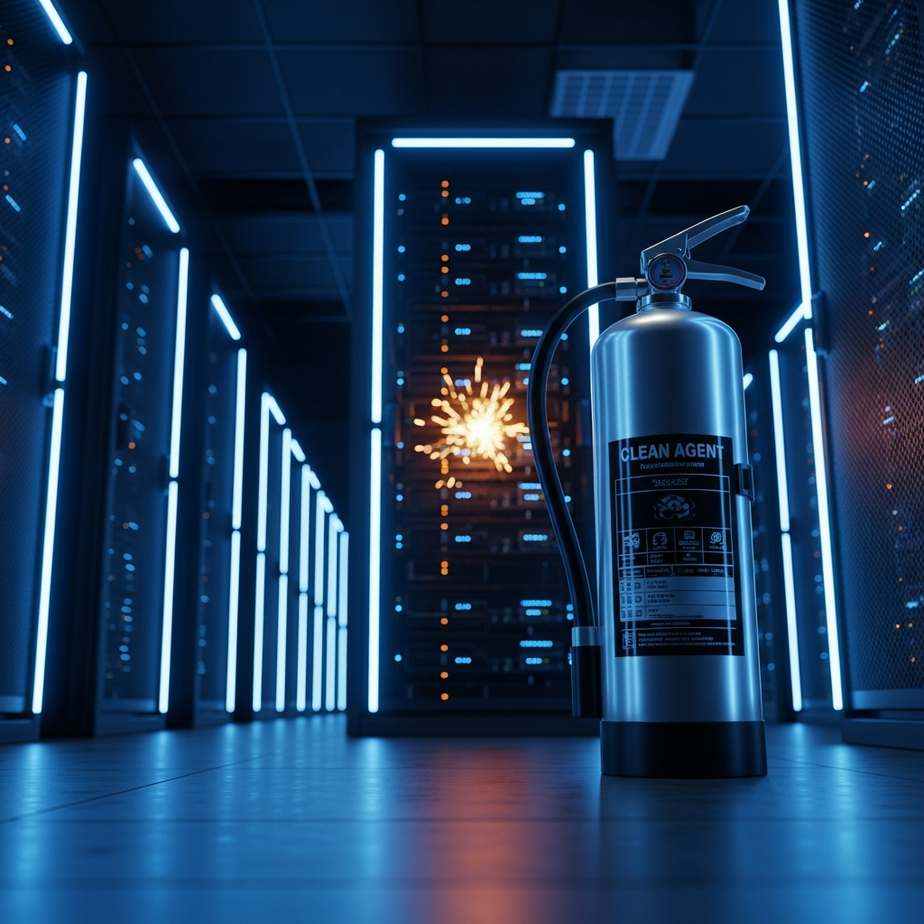
For protecting high-value electronics in places like data centers, server rooms, or broadcasting studios, clean agent extinguishers are the undisputed gold standard. These fire extinguishers for electronics use gaseous agents that are non-conductive, leave no residue, and are safe for use in occupied spaces.
The original clean agent was Halon 1211, but it was phased out due to its severe impact on the ozone layer. Modern replacements offer the same benefits without the environmental damage. According to the National Fire Protection Association (NFPA), these agents are vital for protecting critical assets.
Halotron I
Halotron I is one of the most popular Halon replacements. It is a hydrochlorofluorocarbon (HCFC) based agent that discharges as a rapidly evaporating liquid, leaving no residue.
– Pros: It is an effective, non-conductive, and clean agent that is less damaging to the ozone than Halon. It offers good range and visibility during discharge is not obscured.
– Cons: It is more expensive than CO2 or dry chemical options. While much better than Halon, it still has some ozone depletion potential.
FE-36 (HFC-236fa)
Another excellent clean agent option is FE-36. It’s a hydrofluorocarbon (HFC) that is zero-ozone-depleting, non-conductive, and leaves no residue.
– Pros: Environmentally safer than Halotron, extremely clean, and safe for occupants. It is a preferred choice for new installations in data centers and telecommunication facilities.
– Cons: The primary drawback is its higher cost compared to other types of extinguishers.
Choosing between CO2 and a modern clean agent often comes down to budget versus the value of the assets you are protecting. For an irreplaceable server or a home studio full of expensive gear, the investment in a clean agent extinguisher is easily justified.
How to Choose the Right Electrical Fire Extinguisher
Selecting the perfect fire extinguisher for your electronics depends on your specific environment, the value of your equipment, and your budget. A one-size-fits-all approach doesn’t work when protecting sensitive and expensive technology.
For the Home Office or Entertainment Center
For a typical home setup with a computer, monitor, TV, and gaming consoles, the risk of a total financial catastrophe is lower, but the desire to save your gear is still high.
– Recommendation: A small 5 lb. Carbon Dioxide (CO2) extinguisher is an excellent choice. It’s affordable, effective, and won’t leave a mess on your carpet or inside your PC case.
– Placement: Keep it in an easily accessible location near the equipment but not so close that you’d have to reach over a fire to get it. Under a desk or just outside the office door are good spots.
– Remember the Risks: Be mindful of the ventilation in your room. If you have to discharge it in a small, closed-off office, evacuate the room immediately after use.
For Small Businesses and Server Closets
When you have a small server closet or a rack of networking gear running your business, the stakes are much higher. Downtime costs money, and data loss can be catastrophic.
– Recommendation: This is where a clean agent extinguisher, like one filled with Halotron I or FE-36, becomes a wise investment. A 5 to 11 lb. unit provides good protection without the risks of CO2.
– Cost-Benefit Analysis: While the upfront cost is higher, compare it to the cost of replacing a server, a network switch, and paying for professional data recovery. The clean agent extinguisher quickly pays for itself in a real emergency.
– Placement: The extinguisher should be mounted near the entrance to the server room or closet for quick and safe access.
For Large Data Centers and Critical Infrastructure
In large-scale environments, portable fire extinguishers are just one part of a much larger fire suppression strategy. Protecting millions of dollars in hardware and priceless data requires a comprehensive approach.
– Recommendation: Multiple large clean agent portable extinguishers should be strategically placed throughout the facility. However, the primary defense is often an engineered fire suppression system.
– Fixed Suppression Systems: These systems use the same clean agents (like FM-200 or Novec 1230) but are built into the room. In the event of a fire, the system floods the entire room with the gaseous agent, extinguishing the fire in seconds without damaging any equipment and without requiring human intervention.
Essential Safety Practices for Handling Electrical Fires
Owning the right fire extinguisher is only half the battle. Knowing what to do when seconds count is just as important. In the panic of a fire, muscle memory and prior training take over.
Step One: De-energize the Equipment (If Safe)
Before you even reach for an extinguisher, your first thought should be to cut the power.
– Unplug It: If the fire is small and you can safely reach the cord, unplug the device.
– Hit the Breaker: If you can’t reach the plug, or if the fire involves wiring in the wall, go to your electrical panel and shut off the breaker for that room or the main breaker for the building.
– Why It Matters: Cutting the power removes the “C” element from the fire. This can sometimes cause the fire to extinguish on its own. It also eliminates the risk of electric shock, making it safer to fight the remaining fire (which is now likely a Class A fire).
Use the P.A.S.S. Method
Firefighters teach a simple acronym for using an extinguisher: P.A.S.S.
1. Pull: Pull the pin on the extinguisher. This will break the tamper seal.
2. Aim: Aim the nozzle or hose at the base of the fire, not at the flames themselves. Hitting the base is what puts out the fuel source.
3. Squeeze: Squeeze the handle slowly and evenly to discharge the agent.
4. Sweep: Sweep the nozzle from side to side, covering the base of the fire until it is completely out.
Know When to Fight and When to Flee
Your personal safety is always more important than any piece of equipment. Only attempt to fight a fire if all of the following are true:
– The fire is small and contained.
– You have a clear and unobstructed escape route.
– You have the correct type of fire extinguisher for the fire.
– You are confident you can operate the extinguisher correctly.
If the room is filling with smoke, if the fire is growing rapidly, or if your extinguisher runs out, do not hesitate. Leave immediately, close the door behind you to slow the fire’s spread, and call 911 from a safe location.
Protecting your valuable electronics from a fire goes beyond simply having an extinguisher nearby. It requires having the right kind of extinguisher and the knowledge to use it safely and effectively. A standard ABC unit might put out the flames, but it will leave behind a trail of destruction, turning a minor electrical fire into a total loss of equipment.
By investing in a clean agent or CO2 extinguisher, you are not just buying a safety device; you are buying insurance for your technology. Take a moment to assess your home office, business, or server room. Look at the value of the equipment you rely on every day. Ensuring you have the proper fire extinguishers for electronics is a small, smart investment to protect it all. Don’t wait for the smoke to appear—review your fire safety plan today and equip yourself with the tools that will save your tech, not destroy it.