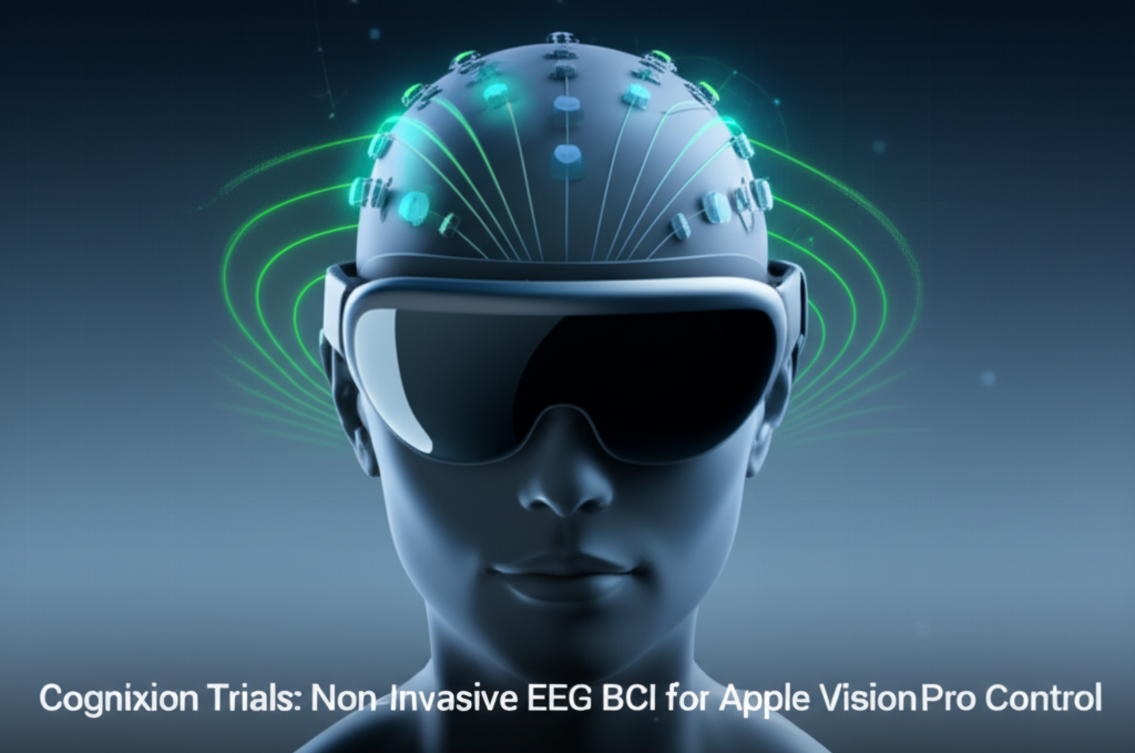
In the rapidly evolving landscape of neurotechnology, the latest development from Cognixion marks a watershed moment: a non‑invasive brain‑computer interface (BCI) that pairs seamlessly with Apple’s Vision Pro headset. While many headlines focus on high‑profile ventures like Neuralink’s implanted arrays, Cognixion’s clinical trial demonstrates that powerful, thought‑based control can be achieved without a single incision. This breakthrough promises to democratize access to augmented reality (AR) for individuals with neurological disabilities such as amyotrophic lateral sclerosis (ALS) and stroke, opening a new frontier in inclusive computing.
How the Cognixion Trial Works
The core of Cognixion’s system is a lightweight, wireless electroencephalography (EEG) headset that captures electrical activity from the scalp. Unlike traditional consumer EEG gear, the device incorporates advanced signal‑processing algorithms that filter out noise and amplify subtle neural signatures associated with visual attention, motor imagery, and intent. When paired with Apple’s Vision Pro, the headset translates these brainwaves into precise commands—turning thoughts into clicks, gaze into selection, and head movements into navigation—all in real time.
Thought‑Driven Control Meets AR Vision
Apple’s Vision Pro is engineered for spatial computing, offering immersive holographic overlays and sophisticated hand‑tracking. Cognixion augments this experience by adding a layer of neural intent. For users who can no longer rely on manual gestures, the BCI provides an intuitive, hands‑free interface. By focusing on a virtual button or using a simple mental cue, the system registers the corresponding EEG pattern and executes the desired action. The synergy between EEG input and Vision Pro’s optical sensors creates a fluid, responsive environment that feels both natural and empowering.
Non‑Invasive vs. Invasive Approaches
While invasive implants like Neuralink’s silicon threads offer high channel counts and fine‑grained control, they come with surgical risks, regulatory hurdles, and limited accessibility for the broader public. Cognixion’s non‑invasive method sidesteps these obstacles. The device can be applied in a standard clinical setting, requires no surgery, and can be reused across multiple users. This makes it an attractive option for widespread deployment, especially in rehabilitation centers, homes, and assisted living facilities where ease of use and safety are paramount.
Clinical Impact for ALS and Stroke Patients
In early-phase trials, Cognixion’s BCI has enabled individuals with advanced ALS to navigate a virtual workspace, control a wheelchair interface, and even type using thought alone. Stroke survivors reported improved confidence in performing daily tasks—such as selecting items on a virtual shelf or interacting with a digital calendar—without relying on compromised motor limbs. The trial data indicate that users experience a measurable increase in autonomy and quality of life, underscoring the therapy’s potential as a complementary tool for neurorehabilitation.
Technical Innovations Behind the Interface
The system’s success hinges on three pivotal innovations:
- Adaptive Signal‑Processing: Machine‑learning models continuously calibrate to each user’s neural patterns, ensuring robust performance across variable brain states.
- Multimodal Fusion: By integrating EEG data with eye‑gaze tracking and inertial measurement units, the platform reduces false positives and enhances command accuracy.
- Low‑Latency Communication: A dedicated wireless bridge ensures that brain‑derived commands reach the Vision Pro in under 100 ms, preserving the real‑time feel crucial for immersive interactions.
Ethical and Regulatory Considerations
Because the device operates purely on surface‑level brain signals, it circumvents many of the ethical dilemmas that plague invasive neurosurgery—such as long‑term tissue response and implant rejection. However, regulators will still scrutinize data privacy, as EEG recordings can potentially reveal sensitive information. Cognixion has incorporated end‑to‑end encryption and strict user consent protocols to address these concerns, positioning itself for smooth approval pathways in the U.S. and European markets.
Future Directions and Market Potential
Beyond assistive technology, Cognixion’s platform is poised to expand into mainstream AR gaming, education, and productivity. Imagine a classroom where students can highlight virtual notes using eye‑movement and thought, or a collaborative workspace where a designer’s mental sketch is instantly rendered in a shared hologram. The convergence of non‑invasive BCI and Vision Pro also opens avenues for remote surgery, tele‑presence, and sophisticated human‑machine interfaces that adapt to the user’s cognitive state.
Conclusion: A Leap Toward Inclusive AR
Cognixion’s clinical trial demonstrates that powerful, thought‑based control is no longer the exclusive domain of invasive research labs. By marrying non‑invasive EEG with Apple’s Vision Pro, the company offers a scalable, low‑risk pathway to truly inclusive augmented reality. This innovation not only elevates the standard of care for people with ALS and stroke but also sets a new benchmark for the broader neurotech industry. As the world moves toward an increasingly digital and immersive future, Cognixion’s breakthrough may well be the catalyst that brings the power of AR within reach for everyone—regardless of physical limitations.