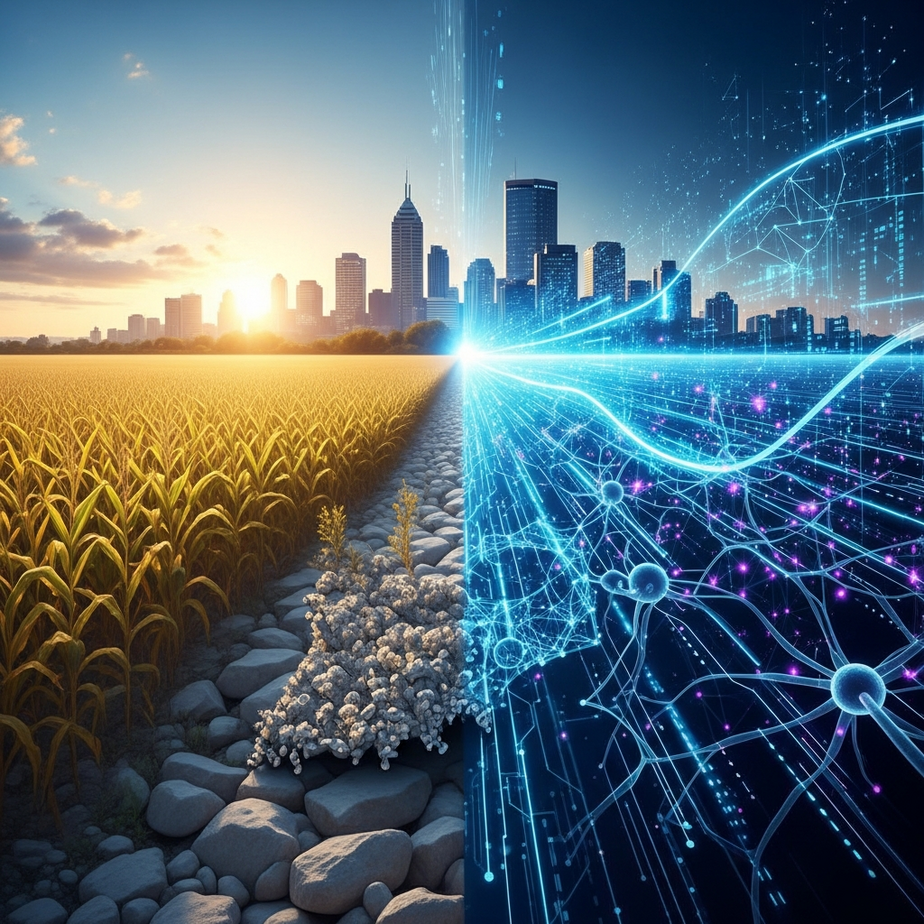
From Horsepower to AI: Indiana’s Legacy of Innovation
On a sweltering July day in 1894, the quiet streets of Kokomo, Indiana, were disrupted by an unfamiliar sputtering sound. Residents watched in awe as Elwood Haynes guided his “Pioneer,” one of America’s first gasoline-powered automobiles, down Pumpkinvine Pike. That moment didn’t just mark a successful test drive; it placed Indiana at the epicenter of an industrial transformation. Today, the Hoosier State stands at a similar juncture, facing not the roar of an internal combustion engine, but the quiet, processing hum of a burgeoning **artificial intelligence revolution**. Just as the automobile reshaped our landscape, economy, and daily lives, AI is poised to redefine our future, and Indiana is uniquely positioned to help lead the charge.
This isn’t a new role for Indiana. The state has a deep-seated history of being a crucible for innovation that changes the world. Beyond Haynes’ automotive breakthroughs, consider the pharmaceutical giant Eli Lilly and Company, founded in Indianapolis in 1876. Its pioneering work in mass-producing penicillin and insulin saved countless lives and established Indiana as a global leader in life sciences. This legacy of transforming groundbreaking ideas into practical, scalable solutions is embedded in the state’s DNA.
From the steel mills of the north to the agricultural heartlands, Indiana has always been a place where things are built, grown, and moved. The state’s identity is forged in manufacturing, logistics, and agriculture—sectors that are now ripe for disruption and optimization. The spirit of the inventor, the engineer, and the problem-solver persists. This historical foundation provides not just a source of pride, but a strategic advantage as we navigate the complexities of the modern **artificial intelligence revolution**.
The Modern Crossroads: Why Indiana is Poised for a Tech Takeover
While its industrial past is impressive, Indiana’s current assets are what truly position it as a future leader in artificial intelligence. The state has quietly been assembling the critical components needed to foster a thriving tech ecosystem: world-class education, a supportive business environment, and deep expertise in key industries that stand to benefit most from AI integration. This isn’t happening by accident; it’s the result of strategic investment and a forward-thinking vision.
A Hub of Higher Education and Research
The bedrock of any technological movement is knowledge, and Indiana’s universities are powerhouses of research and development. Institutions like Purdue University, Indiana University, the University of Notre Dame, and Rose-Hulman Institute of Technology are not just educating the next generation of engineers and data scientists; they are actively pushing the boundaries of what’s possible with AI.
– Purdue University is a global leader, particularly with its focus on “physical AI”—the intersection of artificial intelligence with the physical world. The university’s Institute for Physical AI is dedicated to developing smart systems for everything from advanced manufacturing and autonomous vehicles to precision agriculture.
– Indiana University’s Luddy School of Informatics, Computing, and Engineering is renowned for its programs in AI, machine learning, and cybersecurity, producing a steady stream of talent for the region.
– The University of Notre Dame is making significant strides in AI ethics, data science, and computational research, ensuring that technological advancement is guided by strong moral principles.
These institutions create a powerful gravitational pull for talent and funding, spinning off innovative startups and partnering with established corporations to solve real-world problems.
The Booming Tech Ecosystem
For years, the narrative was that tech talent had to leave the Midwest for the coasts. That story is rapidly changing. Indianapolis has emerged as a legitimate tech hub, anchored by major players like Salesforce and Infosys, which have invested billions in the state. This corporate presence has a ripple effect, fostering a vibrant startup culture and attracting venture capital.
Organizations like TechPoint and Elevate Ventures are crucial to this growth, providing resources, mentorship, and funding to early-stage companies. They champion the state’s tech community, ensuring that innovators have the support they need to scale their ideas. This ecosystem proves that you don’t need an ocean view to build a world-class technology company; the supportive environment in the heart of the Midwest is proving to be fertile ground for the **artificial intelligence revolution**.
Strategic Industry Alignment
Perhaps Indiana’s greatest advantage is the alignment of its traditional economic strengths with the primary applications of AI. The state isn’t trying to become something it’s not; it’s using AI to become a better version of what it already is.
– Advanced Manufacturing: AI-powered robotics, predictive maintenance, and quality control systems are revolutionizing factory floors, making them safer and more efficient.
– Life Sciences: AI is accelerating drug discovery, personalizing medical treatments, and improving diagnostic accuracy at companies across Indiana’s robust biotech and pharmaceutical sector.
– Agriculture (AgriTech): Drones, sensors, and machine learning algorithms are enabling precision agriculture, helping farmers increase crop yields, conserve resources, and operate more sustainably.
– Logistics and Transportation: As the “Crossroads of America,” Indiana is a critical logistics hub. AI is optimizing supply chains, managing fleet logistics, and paving the way for autonomous trucking.
By applying cutting-edge technology to these foundational industries, Indiana can drive immense economic growth and solidify its leadership for decades to come.
Building the Infrastructure for Tomorrow’s Technology
Having the right ingredients is one thing; combining them effectively is another. Indiana is actively building the physical and economic infrastructure needed to capitalize on its potential. This involves deliberate efforts from both the public and private sectors to create an environment where innovation can flourish, from large-scale research parks to policies that attract and retain top talent.
Public-Private Partnerships Fueling Growth
The Indiana Economic Development Corporation (IEDC) has been instrumental in fostering a pro-business climate that encourages technological investment. A prime example is the LEAP (Limitless Exploration/Advanced Pace) Innovation and Research District in Boone County. This massive development is designed to be a hub for hard tech industries, including microelectronics, and is attracting anchor tenants like Eli Lilly.
These partnerships create a virtuous cycle. The state provides the land, infrastructure, and favorable policies. Private companies bring investment, jobs, and cutting-edge research. Universities supply the talent and foundational science. Together, they are building a dedicated home for the industries that will define the 21st century, ensuring the **artificial intelligence revolution** has a physical foothold in the heartland.
The Talent Pipeline Challenge
The single biggest factor that will determine the success of Indiana’s AI ambitions is people. Attracting and retaining a skilled workforce is a challenge for every state, but Indiana is tackling it head-on. Universities are continuously updating their curricula to align with industry needs, adding programs in data science, machine learning, and AI ethics.
Furthermore, initiatives aimed at reskilling the existing workforce are critical. As AI automates certain tasks, new roles requiring different skills will emerge. Programs that help factory workers become robotics technicians or administrative staff become data analysts are essential for ensuring a just transition. The state’s focus on vocational training and lifelong learning will be paramount in equipping Hoosiers for the jobs of the future. The goal is not just to import talent, but to cultivate it from within, ensuring that all residents have the opportunity to participate in the coming economic boom.
Navigating the Challenges of the AI Transformation
No revolution is without its challenges, and the rapid advance of artificial intelligence is no exception. Acknowledging and proactively addressing these hurdles is crucial for ensuring that the benefits are distributed broadly and that potential negative consequences are mitigated. Indiana’s path to leadership requires not just technological prowess, but also thoughtful planning and a commitment to equitable growth.
Ensuring Equitable Growth Across the State
One of the primary risks of any tech boom is the concentration of wealth and opportunity in a few urban centers. While the growth in Indianapolis, Carmel, and Fishers is exciting, it’s vital to ensure that rural and post-industrial communities are not left behind. The promise of the **artificial intelligence revolution** must extend beyond the I-465 loop.
This can be achieved through:
– Promoting remote work opportunities to allow talent to live anywhere in the state.
– Investing in broadband infrastructure to connect rural communities.
– Establishing satellite innovation hubs and co-working spaces in smaller cities.
– Tailoring AI applications to local industries, such as developing AgriTech solutions for farming communities or advanced manufacturing tools for traditional factory towns.
Ethical Considerations and Workforce Disruption
The societal impact of AI is a global conversation, and Indiana must be an active participant. Concerns about job displacement are valid and must be met with robust workforce development and reskilling programs. The state has an opportunity to lead in creating models for how to transition workers from legacy industries into the tech-driven economy of tomorrow.
Moreover, developing AI ethically is paramount. This involves addressing issues of data privacy, algorithmic bias, and transparency. By leveraging the expertise at universities like Notre Dame, Indiana can become a voice for responsible AI development, ensuring that these powerful tools are used to enhance human potential and create a fairer society, not to create new forms of inequality.
What the Artificial Intelligence Revolution Means for Everyday Hoosiers
For many, the term “AI” can feel abstract and distant. But the impact of this technological shift will be felt in tangible ways across every community in Indiana. It’s not just about code and algorithms; it’s about better jobs, improved healthcare, more efficient services, and a higher quality of life. The **artificial intelligence revolution** is a deeply personal one.
Smarter Farming and Advanced Healthcare
Imagine a farmer in Tipton County using an AI-powered drone to monitor crop health, applying water and fertilizer with surgical precision to maximize yield while minimizing environmental impact. This is the promise of AgriTech, making family farms more productive and sustainable for future generations.
In healthcare, envision a patient in Terre Haute receiving a personalized cancer treatment plan developed by an AI algorithm that analyzed thousands of similar cases, leading to better outcomes. This is the power of AI in life sciences, turning Indiana’s pharmaceutical and biotech expertise into life-saving innovations that benefit everyone.
The Future of Manufacturing and Logistics
On a factory floor in Elkhart, AI-driven robots will handle the most dangerous and repetitive tasks, allowing human workers to focus on more complex problem-solving and quality oversight, leading to safer workplaces and higher-paying jobs. This is the future of advanced manufacturing.
Meanwhile, the logistics networks that crisscross the state will become smarter and more efficient. AI will predict shipping delays, optimize delivery routes, and manage warehouse inventory with unparalleled accuracy, reinforcing Indiana’s “Crossroads of America” moniker and lowering the cost of goods for consumers. These advancements will touch every aspect of daily life, making the state a more prosperous and dynamic place to live.
The legacy of Elwood Haynes and his sputtering automobile in Kokomo serves as a powerful reminder: moments of great technological change are moments of great opportunity. Indiana is once again at such a precipice. The state has the academic institutions, the key industries, the strategic vision, and the determined spirit necessary to become a leader in the **artificial intelligence revolution**. By embracing this change, investing in its people, and building on its historic strengths, Indiana can secure its prosperity for the next century.
The path forward requires collaboration, bold investment, and a shared belief that the state’s best days are ahead. The opportunities are immense, from creating high-paying jobs and revitalizing communities to solving some of the world’s most pressing challenges in medicine, agriculture, and manufacturing. It is time to seize this moment. Discover how local businesses, universities, and government are working together to build Indiana’s AI-powered future and find out how you can be a part of this historic transformation.