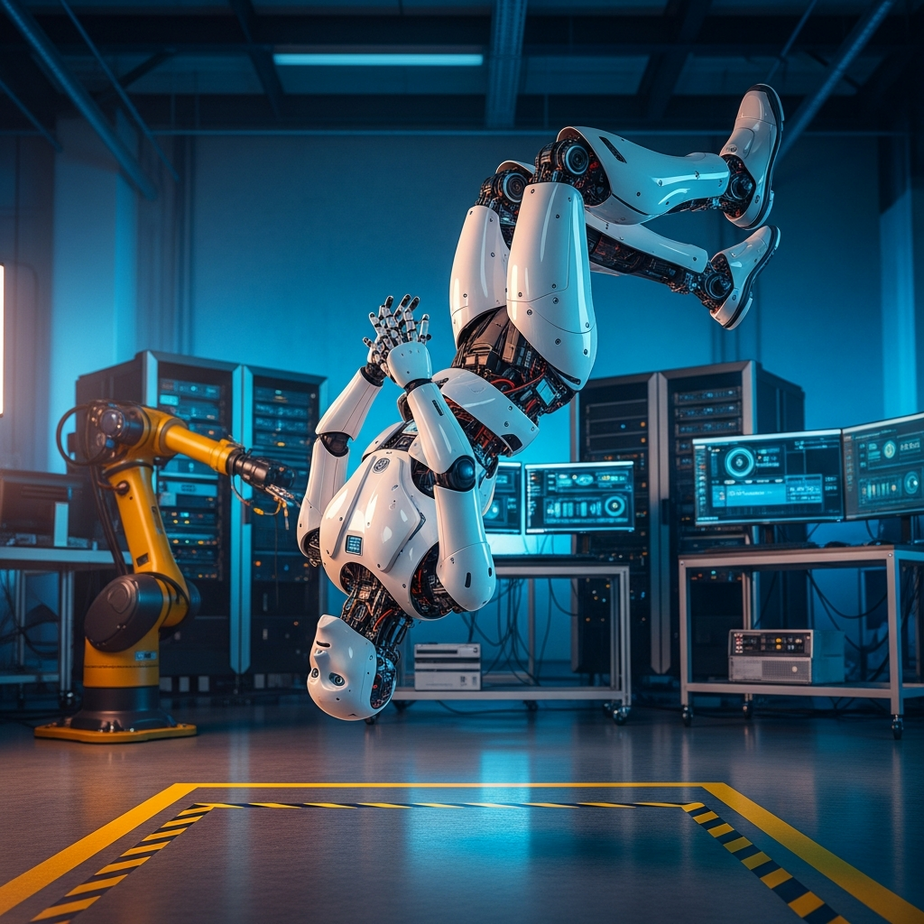
The lights dimmed at CES 2026, creating a hushed anticipation among the thousands of tech enthusiasts, journalists, and industry leaders gathered in Las Vegas. They weren’t just there for the latest smartphone screens or electric vehicles; they were there to see a legend in the world of robotics. When the Atlas humanoid robot strolled onto the stage, the first thing the audience noticed was not the machinery, but the movement. Gone were the jerky, mechanical steps of the past. Instead, the robot moved with a fluid, confident gait that looked eerily human. But the crowd wasn’t just there to watch it walk. Rumors had circulated that Boston Dynamics was planning a live demonstration of dynamic agility that would push the boundaries of what automated hardware could do. The tension in the room was palpable as the machine paused, adjusted its stance, and prepared for a maneuver that even most humans wouldn’t dare try. The Atlas humanoid robot attempted a backflip in front of a live audience, a high-stakes feat where a single degree of miscalculation results in a catastrophic fall. The outcome offered a fascinating glimpse into the future of robotics.
The Evolution of Atlas: From Lab Project to Gymnast
To understand the magnitude of what happened on that stage, it is necessary to look back at where this machine came from. For over a decade, the engineers at Boston Dynamics have been refining bipedal locomotion. Early iterations of Atlas were tethered to ceilings by thick power cables and relied on loud, pressurized hydraulic systems to move their heavy limbs. They were impressive feats of engineering, but they were also cumbersome and strictly confined to laboratory environments. The version seen at CES 2026 represents a massive paradigm shift. This fully electric iteration is lighter, quieter, and significantly stronger than its predecessors. The switch from hydraulics to electric actuators allows for more precise control over movements, which is essential for complex gymnastics. This evolution brings several key improvements: – Enhanced range of motion in the joints allows for deeper squats and tighter tucks.
– Onboard battery power eliminates the need for tethers, granting total autonomy.
– Advanced grip grippers have replaced simple nubs, allowing the robot to interact with the environment more naturally.
– A streamlined form factor reduces the chance of limbs colliding during high-speed rotations. When the robot prepped for its jump, it wasn’t just relying on raw power. It was utilizing years of data on balance, center-of-mass manipulation, and recovery strategies. The goal was to prove that a machine could handle its own weight in a dynamic environment without human intervention.
The Anatomy of the Backflip
Executing a backflip is one of the most difficult challenges in biomechanics. For a human, it requires explosive power, spatial awareness, and the ability to spot a landing while upside down. For a robot, the challenge is mathematical and sensory. The machine must calculate the exact amount of torque needed to launch its body into the air, rotate 360 degrees, and deploy its legs at the precise moment to absorb the impact. During the demonstration, the Atlas humanoid robot crouched low, signaling the initiation of the sequence. The silence in the hall was broken only by the whir of high-torque motors. As it launched upward, the robot tucked its knees to accelerate the rotation—a principle known as the conservation of angular momentum. The critical moment occurred at the apex of the jump. Sensors inside the robot, comparable to the inner ear in humans, had to verify its orientation in real-time. If the rotation was too slow, the robot would land on its back. If it was too fast, it would over-rotate and faceplant. What made this specific attempt at CES 2026 so gripping was the landing. In previous viral videos, we often see the clean takes. In a live environment, there are variables like stage vibration, lighting glare, and uneven surfaces. When Atlas came down, its feet slapped the stage with a heavy thud. It wobbled. Its arms shot out to the sides, shaking violently to counterbalance the momentum. For a split second, it looked like a failure. But the recovery was the true marvel. The control software made hundreds of micro-adjustments in a fraction of a second, stabilizing the torso and bringing the machine to a standing rest. The crowd erupted not because the flip was perfect, but because the recovery was so undeniably human.
Why Agility Matters in Robotics
A common question arose after the applause died down: Why does a robot need to do gymnastics? It is a valid inquiry. In a warehouse or a factory, a robot will never need to perform a backflip to move a box from a shelf to a pallet. However, viewing the stunt purely as a circus trick misses the engineering point. High-level agility acts as a stress test for the robot’s balance algorithms. If a machine can successfully execute a backflip, it possesses the computational reflexes to handle unexpected hazards in the real world. Consider the following scenarios where this technology applies: – Slipping on an oil patch in an automotive factory.
– Tripping over debris at a construction site.
– Navigating the uneven, rubble-strewn terrain of a disaster zone during search and rescue missions.
– Maintaining balance while carrying heavy, shifting loads. The backflip demonstrates that the robot has a “margin of stability.” It proves that the machine can recover from extreme instability. If the Atlas humanoid robot can stabilize itself after a high-velocity rotation, it can certainly handle a sudden shove or a slippery floor without falling over and damaging expensive inventory or injuring human coworkers.
The Technology Inside the Machine
The success of the demonstration relies heavily on what is happening under the hood. The physical shell of the robot is impressive, but the software brain is where the real revolution is happening. Boston Dynamics has integrated Model Predictive Control (MPC) into the system. This allows the robot to predict its future movements and adjust its current actions to meet a desired outcome. Instead of following a pre-recorded animation, the robot is constantly solving physics equations. It knows where its limbs are, how fast they are moving, and where the ground is relative to its feet.
Vision and Perception
To pull off complex maneuvers, Atlas utilizes a suite of depth sensors and cameras located in its head and torso. These sensors build a 3D point cloud of the environment. Before the jump, the robot scanned the stage to ensure the landing zone was flat and clear. This perception stack is crucial for the transition from “blind” automation to “aware” autonomy. Older robots would blindly execute a command even if a person walked in front of them. The new generation of humanoids is designed to perceive, understand, and react to dynamic surroundings.
Power Density and Actuation
The electric actuators used in the 2026 model are marvels of density. They pack enough torque to lift the robot’s entire body weight explosively, yet they are compact enough to fit inside the slender limbs. This shift to electric also means the robot is much quieter. While the hydraulic versions sounded like lawnmowers, the new Atlas operates with a futuristic hum, making it far more suitable for working alongside people in relatively quiet environments.
The Competitive Landscape of Humanoid Robotics
Boston Dynamics is no longer the only player in the field. The display at CES 2026 was also a strategic move to assert dominance in an increasingly crowded market. Companies like Tesla with their Optimus bot, Figure AI, and Agility Robotics are all racing to deploy humanoid workers into commercial spaces. While some competitors focus on mass manufacturability and simple tasks, the Atlas humanoid robot remains the gold standard for dynamic capability. Other robots shuffle cautiously; Atlas sprints and jumps. However, the race is shifting from pure athleticism to utility. The question is no longer “Can it jump?” but rather “Can it work a full shift?” The backflip was a flex of engineering muscle, reminding the world that while others are learning to walk, Boston Dynamics is teaching its machines to dance. The industry is currently focused on two main tracks: 1. General Purpose Humanoids: Robots designed to fit into existing human infrastructure without modification.
2. Specialized Logistics Bots: Bipeds designed specifically for carrying totes and boxes in warehouses. Atlas bridges this gap by showing that general-purpose form factors can achieve specialized levels of performance. The agility displayed suggests that future versions of this robot could work in unstructured environments that would baffle simpler machines.
From the Stage to the Real World
The gap between a CES demo and a commercially viable product is significant. While the backflip was the headline-grabber, the subtle behaviors Atlas displayed were perhaps more important for its future adoption. Between the high-energy stunts, the robot showed it could stand still without jittering, manipulate objects with delicate force, and recover from minor bumps. These are the traits that factory managers look for. A robot that falls over is a liability; a robot that catches itself is an asset. Industry experts anticipate that within the next few years, we will see derivatives of the Atlas technology deployed in pilot programs. We are already seeing early versions of humanoid robots testing in automotive manufacturing plants. They are performing repetitive tasks like attaching trim, inspecting parts, and moving sub-assemblies. The challenge remains cost and durability. A robot that performs gymnastics is expensive to build and maintain. The complex joints and high-end sensors required for a backflip are overkill for stacking boxes. However, the data gathered from pushing the hardware to its limit trickles down to the more utilitarian models, making them cheaper and more reliable over time.
The Human Reaction to Robotic Motion
There is a psychological element to the CES demonstration that cannot be ignored. When the Atlas humanoid robot wobbled after its landing, the audience gasped. It was a moment of empathy. We instinctively root for the biped because it looks like us. This “anthropomorphism” is a double-edged sword. On one hand, it makes us more willing to accept these machines into our workspaces. On the other, it creates an expectation of human-level intelligence that the AI might not yet possess. A robot that moves like a person is expected to think like a person, and we are still far from that reality. The natural gait of the new Atlas helps bridge the “uncanny valley”—the eerie feeling we get when a robot looks almost, but not quite, human. By moving fluidly rather than robotically, Atlas appears less like a horror movie prop and more like a sophisticated tool.
Summary and What Comes Next
The spectacle at CES 2026 was more than just showmanship. When the Atlas humanoid robot attempted a backflip, it was a demonstration of cutting-edge control theory, sensor fusion, and mechanical engineering working in harmony. The slight wobble on the landing didn’t detract from the success; it highlighted the robustness of the system’s recovery algorithms. We are witnessing the maturation of robotics technology. We have moved past the era where bipedal robots were fragile experiments. We are now entering an era where they are robust, dynamic, and increasingly capable of navigating our world on our terms. The backflip proves the robot has the physical capability to survive the chaos of the real world. The next step is giving it the intelligence to do useful work within it. As these machines continue to evolve, the line between what is programmed and what is learned will blur. The agility we see today is just the foundation for the autonomous workforce of tomorrow. If you are interested in how robotics will reshape industries from logistics to healthcare, keep a close eye on Boston Dynamics. The leap they took in Las Vegas is just the beginning.