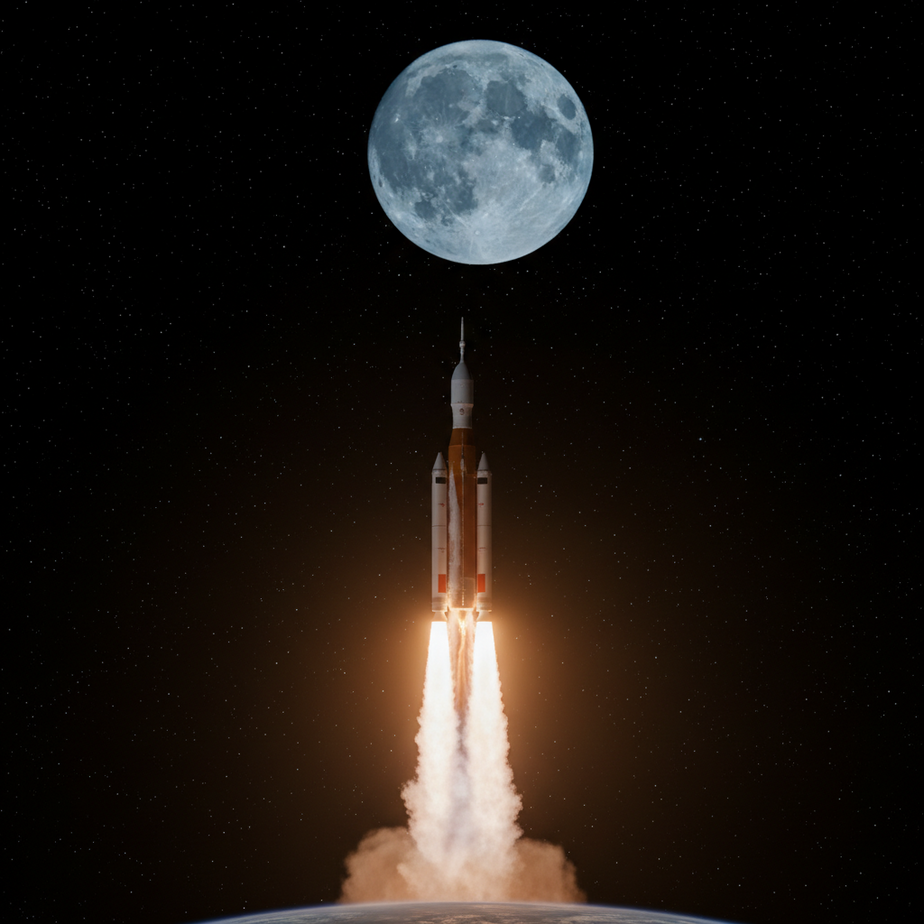
Artemis and the Enduring Call of the Moon: What to Expect as Launch Nears
Excitement around NASA’s Artemis program grows as the launch window nears. The mission seeks to return humans to the Moon and establish a sustainable presence. It builds on Apollo’s legacy while adding new goals and advanced technology.
The Vision Behind Artemis
Artemis aims to return astronauts to the Moon and focus on long‑term exploration. It also intends to land the first woman and the first person of color on the lunar surface. Additionally, the program stresses international partnership and cutting‑edge innovation.
Why the Moon Again? Strategic Goals and Scientific Rationale
Returning to the Moon offers scientific and practical benefits. The lunar south pole may hold water ice in permanently shadowed craters, a valuable resource for future missions. Studying the Moon also lets scientists learn about the early solar system, deep‑space radiation effects, and provides a stable site for astronomical observatories.
Artemis I: The Uncrewed Test Flight
Artemis I is the first uncrewed mission to test the Space Launch System and the Orion spacecraft. It will carry instrumented mannequins to gather data on radiation, vibration, and the Orion heat shield during re‑entry. The flight will travel about 1.3 million miles, orbit the Moon, and return to Earth for a splashdown.
Key Components of the Artemis I Stack
- Space Launch System (SLS) – a heavy‑lift rocket designed to propel Orion beyond Earth orbit.
- Orion Capsule – the crew module that will carry scientific instruments during the test flight.
- European Service Module (ESM) – supplied by the European Space Agency, providing propulsion, power, air, and water.
- Ground Systems – upgraded launch facilities and mission control centers at Kennedy Space Center.
Preparing for Launch
Launching the SLS and Orion demands extensive testing, inspections, and coordination. Weather conditions—wind, rain, lightning, and temperature—must all remain within safe limits. Technical readiness includes integrated tests and fully fueled dry‑run rehearsals, and any anomalies must be resolved before the launch.
Understanding Launch Windows
Launch windows are specific periods when a rocket can reach its intended destination. For lunar missions, they depend on the relative positions of Earth and Moon. If a window is missed, one must wait for the next opportunity, often days or weeks later.
Beyond Artemis I
Future missions will build on Artemis I’s results. Artemis II will be the first crewed test flight, sending astronauts around the Moon and back to Earth, while Artemis III will land humans on the Moon again, targeting the south pole. The Lunar Gateway will also provide a small orbiting space station to support surface missions and test Mars‑related technologies.
- Artemis II – the first crewed test flight, sending astronauts around the Moon and back to Earth.
- Artemis III – the first human landing on the Moon since 1972, targeting the south pole region.
- Lunar Gateway – a small orbiting space station that will support lunar surface missions and serve as a testbed for Mars‑related technologies.
International Collaboration
Artemis partners with nations worldwide. The European Space Agency supplies the ESM for Orion, while the Canadian Space Agency contributes Canadarm3 for the Gateway. Other countries, such as Japan, participate through the Artemis Accords, which promote peaceful and responsible exploration.
The Legacy of Apollo and the Spirit of Exploration
Artemis echoes the pioneering spirit of missions such as Apollo 8, which orbited the Moon in 1968. Both programs showcase humanity’s curiosity and our desire to explore beyond Earth. The new program expands on that legacy by focusing on sustainability and international cooperation.
Impact on Humanity and Future Generations
Artemis is expected to inspire a new generation of scientists and engineers. By showcasing diverse astronauts, it provides powerful role models. The technological advances developed for lunar missions will also benefit medicine, energy, and environmental protection on Earth.
Frequently Asked Questions
What is the primary goal of the Artemis program?
The program aims to return humans to the Moon, land the first woman and the first person of color, and establish a long‑term presence that will serve as a stepping stone to Mars.
How does Artemis differ from the Apollo missions?
Unlike Apollo’s rapid lunar landings, Artemis emphasizes sustainable exploration, international collaboration, and the development of infrastructure such as the Lunar Gateway.
Who are the international partners in Artemis?
Key partners are the European Space Agency, the Canadian Space Agency, and other nations that have signed the Artemis Accords to promote peaceful lunar exploration.
When is Artemis expected to land humans on the Moon again?
After the uncrewed Artemis I test flight and the crewed Artemis II mission, NASA will launch Artemis III for the first human landing since 1972. The exact date depends on mission readiness and technical progress.