The Pre-M1 World: A Stagnant Landscape of Compromise
It’s easy to forget what the laptop market was like before late 2020. For years, the story was one of incremental gains and frustrating trade-offs. If you wanted power, you sacrificed battery life and portability. If you wanted a thin, light machine, you accepted throttled performance and the constant hum of a struggling fan. This was the era of compromise, and Apple’s Mac lineup, powered by Intel processors, was no exception.
For professionals, buying a MacBook Pro often felt like a gamble. Would the machine handle a 4K video render without sounding like a jet engine? Could it compile code for hours without dropping performance due to thermal constraints? While elegant in design, the internal architecture was bound by the limitations of a third-party chip designer, leading to a disconnect between Apple’s hardware and software ambitions.
The iconic MacBook Air, while a pioneer of the ultrabook category, had long languished with underpowered processors that were just enough for basic tasks. The dream of a device that was both whisper-quiet and astonishingly powerful, with a battery that lasted all day under heavy use, seemed like a distant fantasy. The industry had hit a plateau, and consumers were conditioned to accept that you simply couldn’t have it all. This stagnation set the stage for one of the biggest disruptions in the history of personal computing.
A Bet-the-Company Moment: The Genesis of Apple Silicon
Behind the scenes at its Cupertino headquarters, Apple was planning a seismic shift. The decision to ditch Intel, a partner for nearly 15 years, and design its own processors for the Mac was a monumental risk. It meant rewriting the foundational code of macOS and convincing millions of developers to recompile their applications for a completely new architecture. A failure here wouldn’t just be an embarrassment; it could cripple the entire Mac ecosystem.
This audacious plan wasn’t born overnight. It was the culmination of over a decade of experience designing the A-series chips that power the iPhone and iPad. With each generation, Apple’s silicon engineering team grew more confident and capable, creating mobile processors that consistently outclassed the competition in raw performance and, crucially, in performance-per-watt. Apple saw an opportunity to bring this same integrated approach to the Mac.
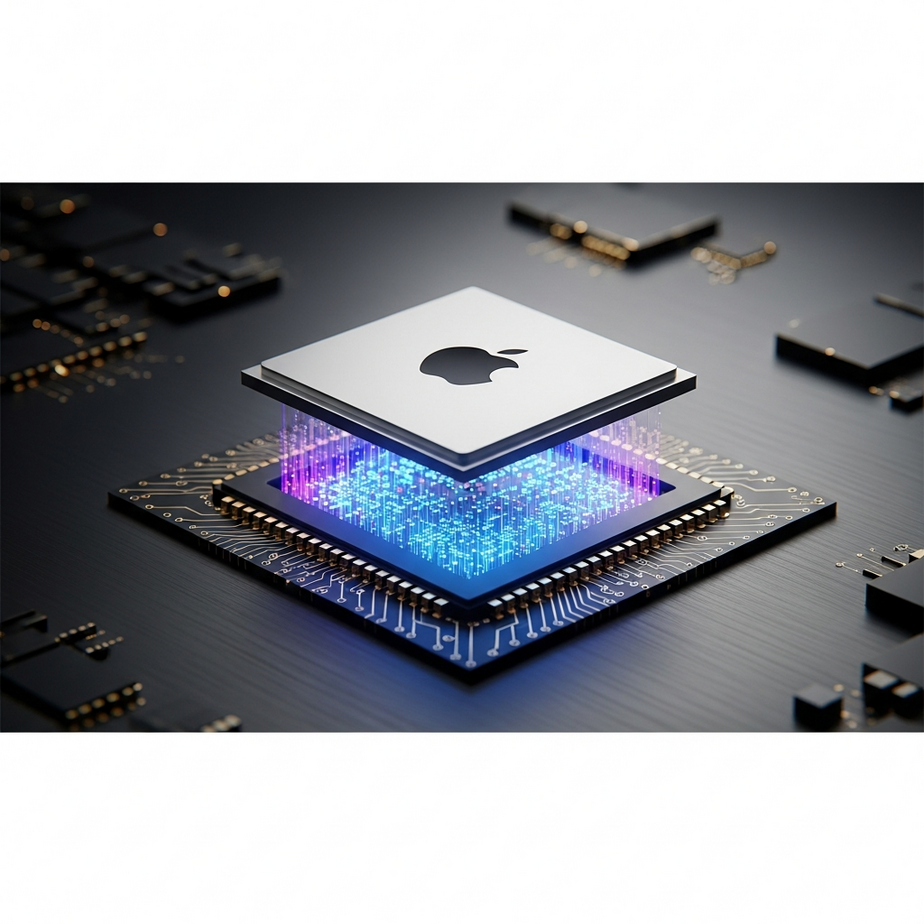
By controlling the entire technology stack—from the silicon to the software—Apple could achieve a level of optimization that was impossible with off-the-shelf components. The goal was to break free from the industry’s cycle of compromise and build computers that were fundamentally better. They envisioned machines that were faster, more efficient, and capable of unlocking new experiences. This vision led directly to the creation of a processor that would send shockwaves through the tech world: the Apple M1 chip.
The M1 Arrives: Redefining Performance and Efficiency
When Apple unveiled the first Macs powered by the Apple M1 chip in November 2020, the presentation was filled with bold claims of massive performance leaps and incredible battery life. The tech community was intrigued but skeptical. We had heard lofty promises before. Then, the first reviews landed, and the skepticism evaporated, replaced by sheer astonishment.
The new MacBook Air, MacBook Pro, and Mac mini didn’t just inch past their Intel-based predecessors; they obliterated them. Tasks that would have brought older machines to their knees were handled with silent, effortless grace. The Apple M1 chip wasn’t just an incremental update; it was a generational leap that fundamentally changed the expectations for a personal computer.
Unprecedented Performance-per-Watt
The true genius of the M1 wasn’t just its speed, but its efficiency. The key metric that changed the game was performance-per-watt. In simple terms, the M1 delivered industry-leading performance while sipping power. This meant it could run at its peak for longer without overheating or draining the battery.
Intel and AMD had been focused on a brute-force approach, pushing clock speeds higher at the cost of heat and power consumption. Apple, leveraging its mobile chip expertise, took a different path. The M1’s architecture was designed from the ground up for efficiency, allowing it to perform demanding tasks using a fraction of the energy of its competitors.
The Silent Revolution: Fanless Designs and All-Day Battery Life
The most dramatic demonstration of the M1’s efficiency was the fanless MacBook Air. For the first time, users could edit 4K video, compile complex code, or work with massive photo libraries on a razor-thin laptop with absolutely no fan noise. It was a magical experience that felt like a glimpse into the future.
This efficiency also translated into staggering battery life. Suddenly, the idea of leaving your charger at home for the day wasn’t a risky move but a normal occurrence. Users reported working for 15, 16, or even 18 hours on a single charge. This wasn’t just a marketing claim; it was a real-world benefit that transformed how people used their laptops, untethering them from the wall socket.
Unified Memory Architecture: A Secret Weapon for Speed
Another key innovation of the Apple M1 chip was its Unified Memory Architecture (UMA). Traditionally, a computer’s processor (CPU) and graphics processor (GPU) have their own separate pools of memory. Data has to be copied back and forth between them, creating a bottleneck that slows things down.
Apple’s UMA puts a single, high-speed pool of memory accessible to the CPU, GPU, and Neural Engine simultaneously. This eliminated the need for data copying, drastically reducing latency and boosting overall system responsiveness. It was a key reason why an M1 Mac with 8GB of RAM often felt faster and more capable than a competing PC with 16GB. For a deeper technical dive into this architecture, Ars Technica’s analysis remains a valuable resource.
The Ripple Effect: How Apple’s M1 Chip Changed the Entire Industry
The launch of the Apple M1 chip was a wake-up call for the entire PC industry. It wasn’t just a new product; it was a declaration that the old rules no longer applied. For years, Intel had operated with a comfortable lead, but suddenly its top-tier chips were being outperformed by Apple’s entry-level laptop processor. The shock was immediate and profound.
Competitors were forced to react. Intel scrambled to reorient its roadmap, accelerating its plans for more efficient architectures. AMD, which was already on an upswing with its Ryzen processors, doubled down on efficiency as a key selling point. Perhaps the most significant reaction has come from Qualcomm, which has been working for years to bring ARM-based computing to Windows PCs. The success of Apple Silicon gave this effort a new sense of urgency, culminating in the development of the Snapdragon X Elite chip, which is explicitly designed to compete with Apple’s M-series.
The M1 didn’t just light a fire under other chipmakers; it fundamentally reset consumer expectations.
– All-day battery life became a baseline expectation, not a premium feature.
– Silent, cool operation was no longer a pipe dream.
– The idea that a thin and light laptop could also be a performance powerhouse became the new standard.
Apple proved that a vertically integrated model, where one company designs the chip, the hardware, and the software, could yield incredible results. This prompted other companies, like Microsoft with its Surface line, to deepen their collaboration with chip partners in an effort to replicate some of that synergy.
Beyond M1: The Evolution and Future of the M-Series
The Apple M1 chip was just the beginning. In the five years since its debut, Apple has relentlessly expanded its silicon lineup, creating a family of chips that scales from its most portable laptop to its most powerful desktop workstation. The M1 was followed by the even more capable M2 and M3 generations, each offered in several configurations:
– **Pro:** For professionals needing more CPU and GPU cores.
– **Max:** For creative power users working with high-resolution video and 3D rendering.
– **Ultra:** A groundbreaking design that essentially fuses two Max chips together for unparalleled desktop performance.
This methodical expansion has allowed Apple to complete its transition away from Intel across the entire Mac lineup, from the iMac to the Mac Pro. But the evolution isn’t just about making things faster; it’s about adding new capabilities.
The AI Imperative: On-Device Intelligence
A key component of every M-series chip is the Neural Engine, a dedicated processor core designed to accelerate machine learning (ML) and artificial intelligence (AI) tasks. While present since the beginning, its importance is growing exponentially. Apple’s strategy is focused on on-device AI, where tasks are processed locally on the Mac rather than in the cloud.
This approach offers two major advantages: speed and privacy. By keeping your data on your device, Apple can offer powerful AI features—like advanced photo editing, real-time voice transcription, and predictive text—without compromising user privacy. As AI becomes more integrated into our daily workflows, the power and efficiency of the M-series Neural Engine will become one of its most critical selling points.
Pushing into New Frontiers: Vision Pro and Beyond
The power and thermal efficiency of the M-series architecture haven’t just revitalized the Mac; they’ve enabled entirely new product categories. The Apple Vision Pro, a sophisticated spatial computer, is powered by an M2 chip working in tandem with a new R1 chip. It simply wouldn’t be possible to pack that much performance into a wearable headset using the power-hungry x86 chips of the past.
The M-series gamble of five years ago has paid off in ways that extend far beyond the Mac. It has given Apple a technological foundation to build the next generation of computing devices. The principles of performance-per-watt, unified memory, and specialized engines for tasks like AI are now core to Apple’s product philosophy.
Five years on, the revolution started by the Apple M1 chip continues to unfold. What began as a risky bet to revitalize the Mac has reshaped the entire personal computing industry and laid the groundwork for the next decade of innovation. The M-series is no longer just a processor; it’s the engine driving Apple’s vision for the future of technology. As this powerful silicon finds its way into more devices and enables increasingly intelligent software, the true impact of ditching Intel is only just beginning to be felt. To see how these advancements can enhance your own work and creativity, explore the latest lineup of M-powered devices and experience the future of computing firsthand.